Category Archives: General Stuff

More books for sale

I am seriously down-sizing my library. I managed to clear about 90% of the books I took to the 2025 AES Annual Exhibition. Here are a few left-overs that were not snapped up.

Please email me at bugmanjones@hotmail.com and I will calculate postage and send an invoice. I have given weights so you can get a feel for the level of postage that might be required.

Arnett, R.H. Jr. 1993. American insects. A handbook of the insects of America north of Mexico. Gainsville: Sandhill Crane Press. 850 pp, 280 x 215 mm. Many b/w illustrations. top corner very slightly bumped. Soft cover. Good condition. 2000 g. £20

Emmet, A.M. & Heath, J. eds. 1991. The moths and butterflies of Great Britain and Ireland. Volume 7, Part 2, Lasiocampidae — Thyatiridae, with a life history chart of the British Lepidoptera. Colchester: Harley Books. 398 pp, 4 colour plates. 260 x 210 mm. Original cloth, very good condition with dust jacket. 1510 g. £15.

Fiedler, K. 1940. Monograph of the South American weevils of the genus Conotrachelus. London: Trustees of the British Museum. 366 pp, 255 x 160 mm. Original cloth. Previous owner’s book plate and signature. 900 g. £10

Goater, B. 1986. British pyralid moths. A guide to their identification. Colchester: Harley Books. 176 pp, 220 x 155 mm. colour frontis and 8 colour plates, several b/w illustrations. Original cloth, with dust jacket. Good condition. £10

Heie, O.E. 1980, 1982, 1986. The Aphidoidea (Hemiptera) of Fennoscandia and Denmark. parts 1, 2 and 3. Fauna Entomological Scandinavica volumes 9, 11 and 17. 236, 176 and 314 pp, 210 x 145 mm. many b/w illustrations and 8 colour plates. Previous owner’s bookplate, otherwise good condition. Volumes 1 and 2 are in soft covers, volume 3 is hardback. 1230 g. 3 vols £30

Holloway, J.D., Bradley, J.D., Carter, D.J. & Betts, C.R. 1987. CIE guides to insects of importance to man. 1. Lepidoptera. London: CABI, BMNH. Soft cover, spiral bound. 262 pp, 265x195mm. Many b/w illustrations. good condition. 750g. £5

Kieffer, J.-J. 1879? Species des hyménoptères d’Europe & d’Algérie. Volume 7. Cynipidae. Paris: Froment. Pages 289-748, 250×165 mm, b/w engraved plates X-XXI. Disbound. Contents holding together but front cover completely off, and back cover and spine loose and broken. This is only half the volume 7, which much must have been originally bound up in two parts. 1350g. £10

Kasparyan, D.R. 1989. Fauna of the USSR. Hymenoptera. Volume 3, number 1. Ichneumonidae (Subfamily Tryphoninae) Tribe Tryphonini. Leiden: Brill. 414 pp, 240 x 160 mm. Many b/w illustrations. Original cloth. Good condition. 850 g. £10.

Locket, G.H. & Millidge, A.F. (and Merrett, P.) 1951, 1953, 1974. British spiders. 3 volumes. London: Ray Society. 310, 450 and 314 pp, 220 x 140 mm. Many b/w illustrations. Original black cloth. Volume 3 with dust jacket. Volumes 1 and 2 with some small museum library stamps on fly leaves and title pages. Volume 3 very good condition. 1750 g. 3 vols SOLD.

Matthews, E.G. 1980-1992. A guide to the genera of beetles of South Australia. Parts 1-6 (of 8 published). 66, 64, 60, 68, 68 and 76 pp, 250 x 175 mm, many b’w illustrations. softbacks. previous owner’s bookplates. Good condition. 1300 g. 6 parts £15.

Michener, C.D., McGinley, R.J. & Danforth, B.N. 1994. The bee genera of North and Central America. Washington: Smithsonian Institution Press. 201 pp. 285 x 220 mm. Many b/w illustrations. Original cloth. Very good condition with dust jacket. 1115 g. SOLD.

Mosely, M.E. 1939. The British caddis flies (Trichoptera). A collector’s handbook. London: Routledge. 320 pp, 250 x 160 mm. Many b/w illustrations. Original cloth, some marking and scuffing. An ex library copy, but apart from the usual stamps on fly leaf and tear where the lending card pocket has been roughly removed, the contents are good and clean. Library shelf number on the spine has been removed leaving a scuff mark. 900 g. £10

Palm, T. 1948, 1961, 1968, 1970, 1972. Svensk insektfauna utgiven av Entomologiska Foreningen i Stockholm. 9. Skalbaggar, Coleoptera, Kortvingar: Fam. Staphylinnidae. Parts 1 (Micropeplinae, Phloeocharinae, Olisthaerinae, Proteininae, Omalinae), 2 (Oxytelinae, Oxyporinae, Steninae, Euaesthetinae), 5 (Aleocharinae Deinopsis – Trichomicra), 6 (Aleocharinae – Atheta) and 7 (Aleocharinae Aleunota – Tinotus). Stockholm: Entomologiska Foreningen. 134pp, 126pp, 468pp (last three parts consecutively numbered), 205x145mm (parts 1&2), 215×145 (parts 5, 6, 7). Original card wrappers. Many b/w illustrations including 21 and 7 whole-page plates of aedeagus pictures. Book plates and signatures of previous owner. Otherwise very good condition. 1100 g. 5 parts £25.

Pierre, C. 1924. Faune de France, 8, Dipteres, Tipulidae. Paris: Lechevalier. 160 pp 245 x 160 mm. numerous b/w illustrations. Hardback. Good quality library style binding incorporating the original soft paper wrappers. Some stamps and stickers inside covers, otherwise good condition. 530 g. £10

Plant, C.W. 2008. The moths of Hertfordshire. Hertfordshire Natural History Society. 542 pp, 300 x 210 mm, Numerous colour illustrations and many 2-colour maps. Original hardcover. Good condition. 2400 g. £15

Salmon, M.A. 2000. The aurelian legacy. British butterflies and their collectors. Colchester: Harley Books. 432 pp. 280 x 210 mm. Many colour and b/w illustrations. Very good condition, with dust jacket. 1700 g. £10.

Spradbury, J.P. 1973. Wasps. An account of the biology and natural history of solitary and social wasps with particular reference to those of the British Isles. London: Sidgwick & Jackson. 408pp. 240x160mm. Many b/w (and a few colour) illustrations. Original cloth slightly faded, contents good. 1200g. SOLD.

Microscopes for sale

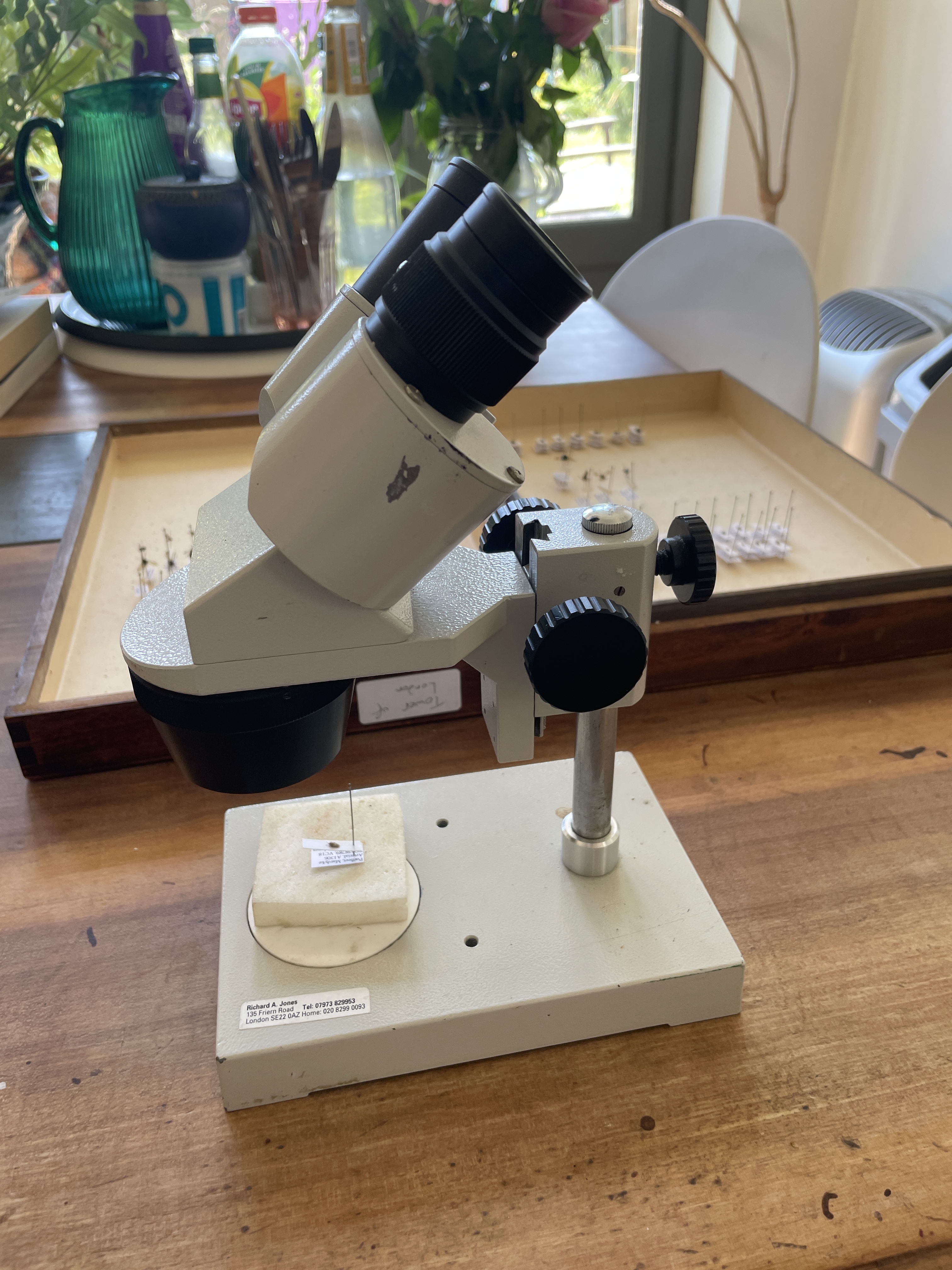
I’ve got the following stereomicroscopes for sale. All pretty well used over the years, but all in useful workable condition. I mainly had them for workshops and group activities, but they are now all surplus to requirements. All would suit someone new to entomology looking to get a cheap first scope. Buyer to collect from south-east London. Please email me at bugmanjones@hotmail.com if interested to come and see any of them.

Meji SKC-1. Swivel turret scope on simple base. 10x eyepieces. x1 and x3 objectives giving x10 and x30 magnifications. Stands 26 cm high. £45

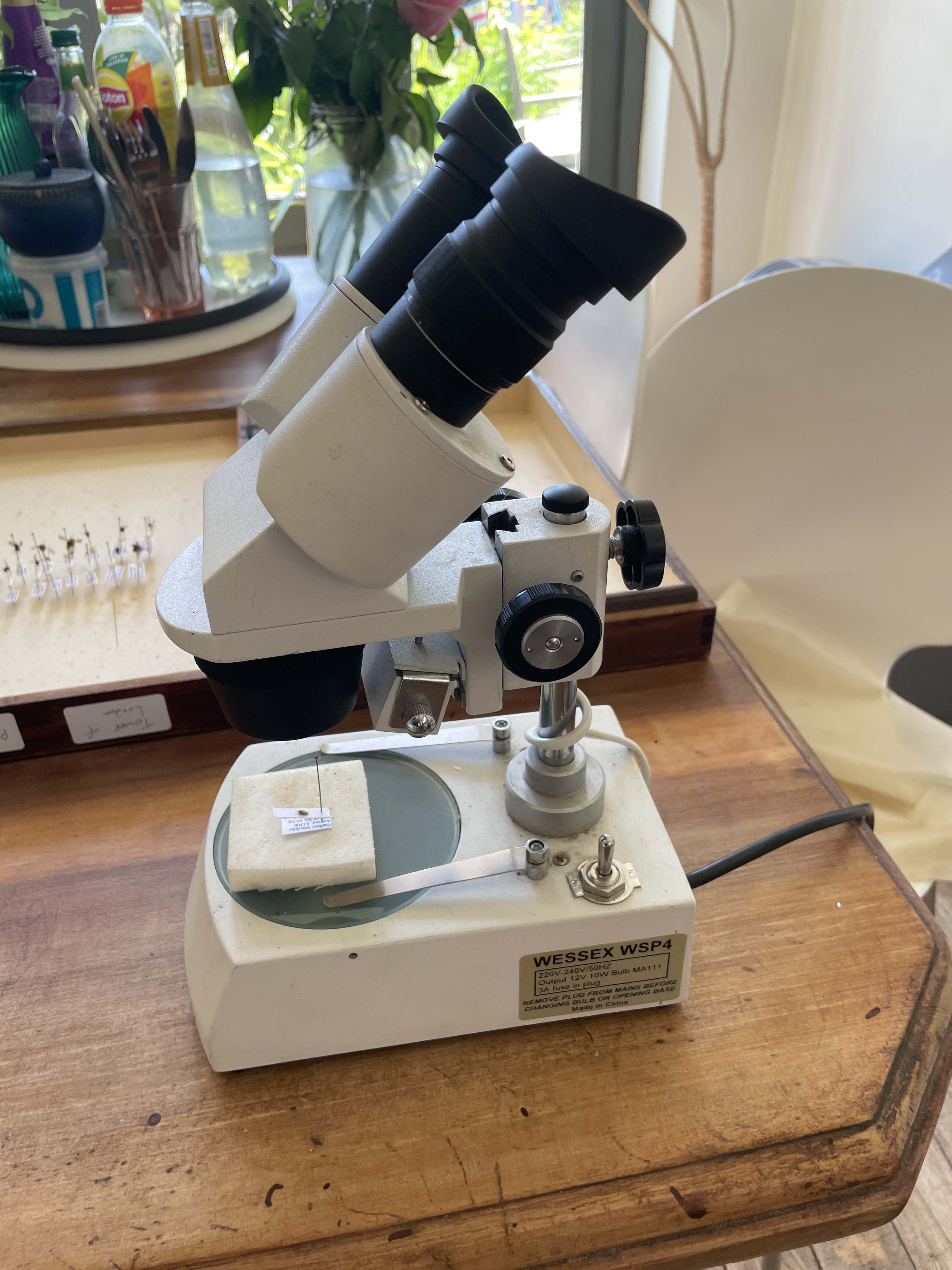
Wessex WSP4. Swivel turret scope on light-projecting base. 10x eyepieces. x1 and x3 objectives giving x10 and x30 magnifications. Stands 32 cm high. Built in lights — objective above and transmission below. £55

Meji SKT. Swivel turret scope on light-projecting base. 10x eyepieces. x1 and x3 objectives giving x10 and x30 magnifications. Stands 30 cm high. Built in transmission light from below and objective light from above. The ratchet keeping the focussing handle stiff and in place is stuck so the only way to focus it at the moment is to raise and lower the entire head. Might be repairable. £35

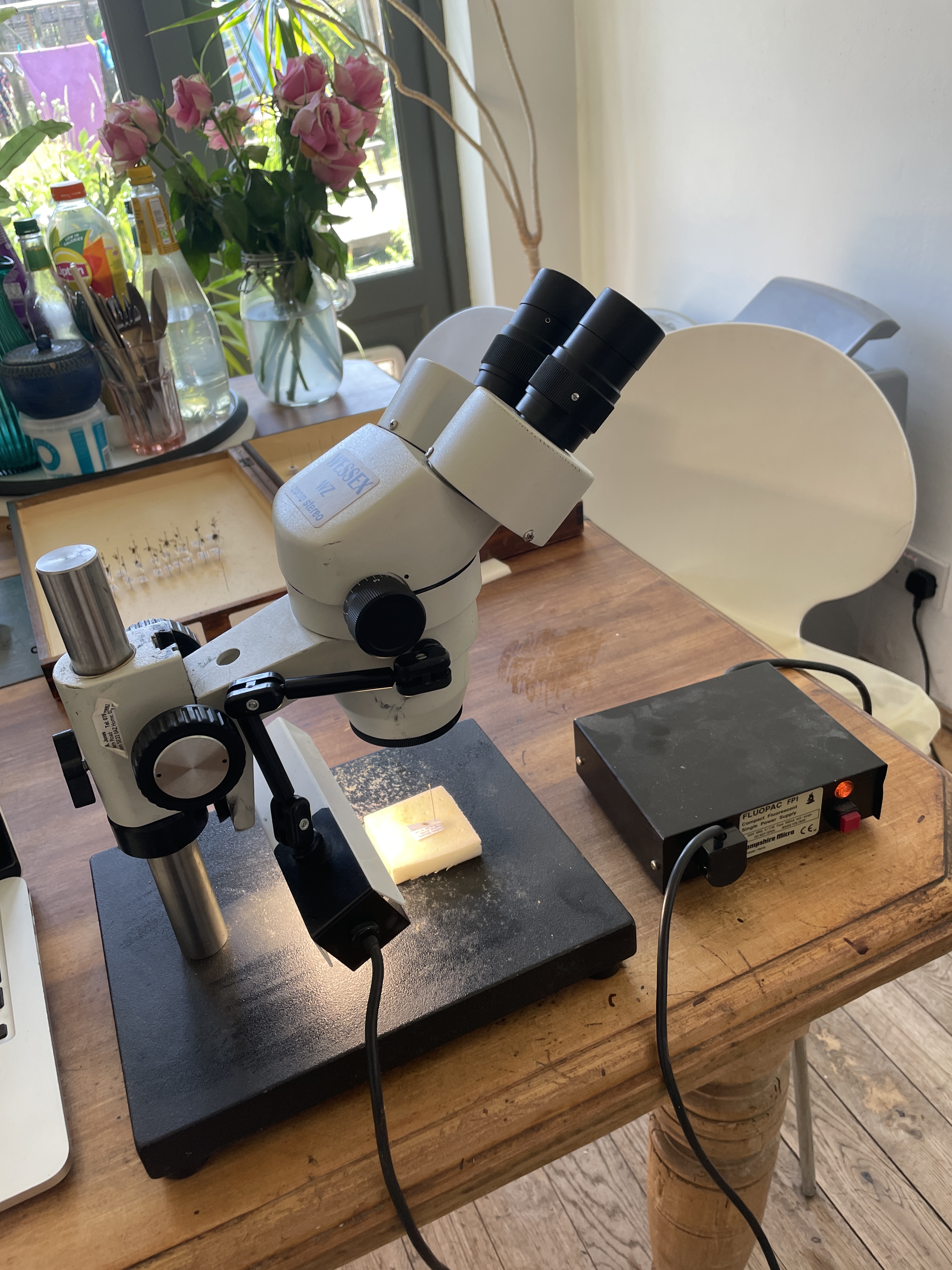
Wessex WZ zoom. x10 eyepieces, zoom x1 – x 4 giving x10 to x40 life size zoom. Built in flourescent light on angled adjustable arms powered by separate power supply box. Stands 37 cm high. Comes on very heavy solid metal base26cm x 20cm. £150

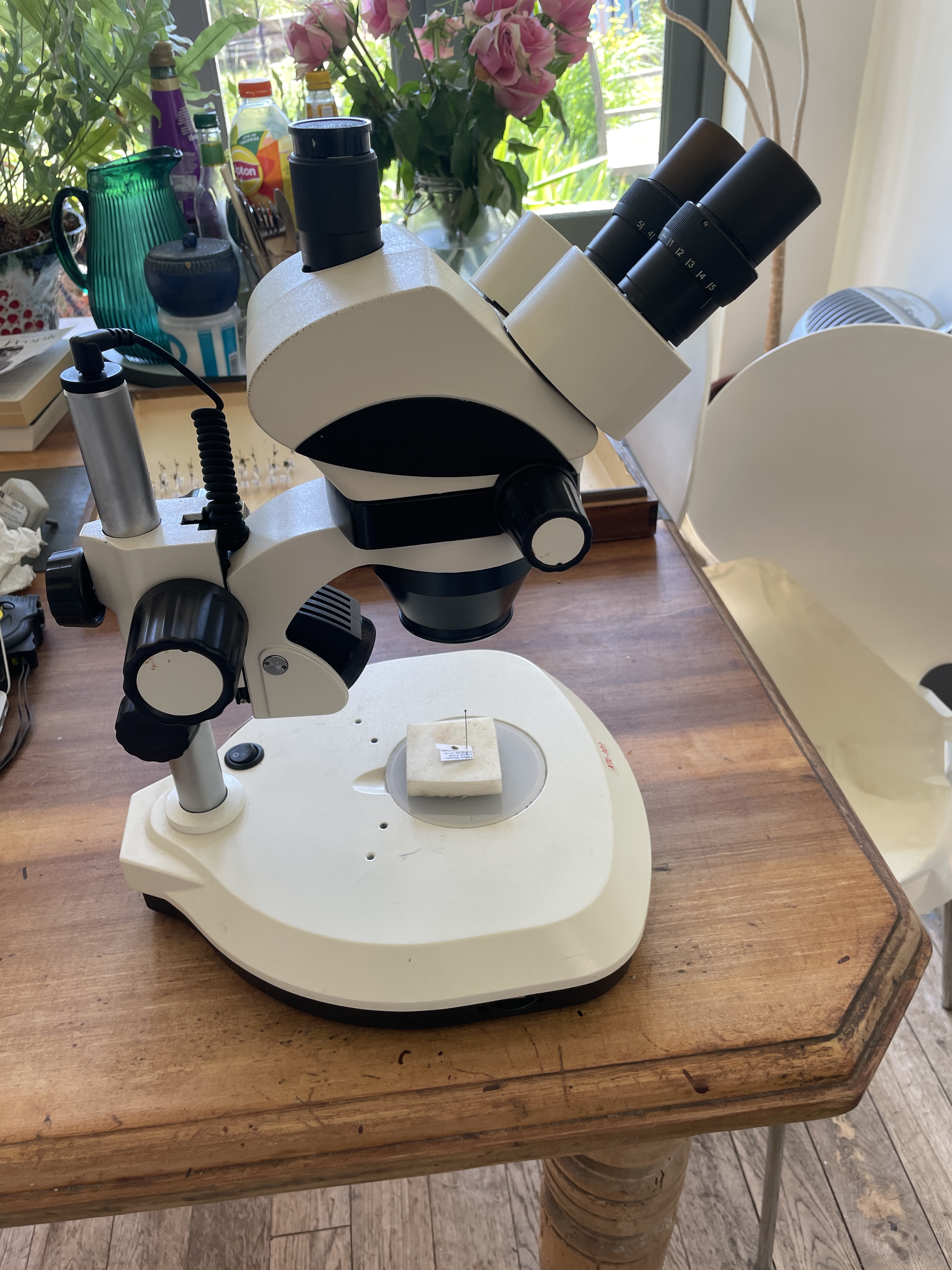
XTL-101 zoom. x10 eyepieces, zoom 0.7 – 4.5 giving x0.7 to x45 life size magnifications. Has built-in transmission and objective lights, but I no longer have the power adaptor to fit it. I used it with an external angle-poise light whenever I needed and it was fine. Stands 40 cm high. Has extra objective stalk for attaching a camera, although I have never used this. The ratchet for keeping the focussing knob still and stiff is loose, so if you let go of it the head drifts out of focus. Might be fixable. £150.

Books for sale

I am seriously down-sizing my library.

I shall be taking a stand at this year’s Amateur Entomologists’ Society Annual Exhibition at Kempton Park, Saturday 27 September 2025, where I will be selling off a large number of titles at real knock-down prices.

But there are several things which are too bulky and perhaps a bit too specialist/ technical, so I have prepared the following list.

Many have my signature and bookplate inside the front covers. Other details are given in the descriptions.

Please email me on bugmanjones@hotmail.com and I will respond, on a first-come-first-served basis, with an invoice which will include the additional costs of postage and packing. Several large heavy items might be easier collected from south-east London and I am happy to try and accommodate this.

Ambrose, D.P. 1999. Assassin bugs. New Hampshire: Science Publishers. 228 pp. 240 x 155. 4 colour plates and several b/w photos and diagrams. Pictorial hardcover. Good condition. SOLD

Arnett, R.H. Jr. 1993. American insects. A handbook of the insects of America north of Mexico. Gainesville: Sandhill Crane Press. 850 pp. 280 x 215 mm. Numerous b/w photographs and illustrations throughout. Soft card covers. Good condition. £35.

Balachowsky, A.  & Mesnil, L. 1935. Les insectes nuisibles aux plantes cultivees. Paris. Two volumes, bound as three: Vol 1 chapters 1 & 2 736pp, Vol 1 chapter 3 pp 737-1140, Vol 2 pp 1141-1924. 270 x 210 mm. Illustrated throughout with b/w photos and drawings, and 7 colour plates. Rebound in rexine using original cloth labels, good condition. 3 large volumes £55.

Chenu, Dr. 1860. Encyclopedie d’histoire naturelle. Coleopteres. 3 volumes, bound in two. 312 pp + 312 pp, 290 x 190 mm, bound together. 360 pp, 290 x 190 pp. Many line illustrations throughout and many full-page plates. Modern (1950s?) cloth binding, some spotting to paper, otherwise pretty good condition. Two large volumes SOLD

Cherepanov, A.I. 1990-1991. Cerambycidae of Northern Asia. Leiden: Brill. 642pp, 292pp, 354pp, 300pp, 308pp, 396pp. 240 x 155 mm. Very many line drawings and illustrations throughout. All very good condition, original cream hardbacks, all with dust wrappers. Spines of dust wrappers slightly sun-faded, otherwise very good condition. Six volumes £180.

Chvala, M., Lyneborg, L.  & Moucha, J. 1972. The horse flies of Europe. Copenhagen: Entomological Society of Copenhagen. 500 pp. 5 colour and 3 b/w plates. Numerous b/w illustrations throughout. Cloth hardcover, slightly scuffed in one corner of front cover. Contents good condition. SOLD

Cole, F.R. 1969. The flies of western North America. Berkeley: University of California Press. 692 pp. 290 x 220 mm. Numerous b/w illustrations throughout. Cloth binding slightly pulled inside. Front fly leaf torn out. Otherwise good condition. Contains carbon copy of letter from Charles P. Alexander, thanking the author for the book. £12

Coleopterists Bulletin. Published by the Coleopterists Society (USA). 1990–2002. Volumes 44–56. Original card wrappers, 4 parts per volume. Approximately 500 pp per volume. 230 x 152 mm. Illustrated throughout with b/w figures. Also included matching Coleopterists Society Monograph 1, 2002, 96 pp. Good condition. The lot, 13 volumes, 52 + 1 = 53 parts. SOLD

Collin, J.E. 1961. British flies. Vol. VI. Empididae. Cambridge: Cambridge University Press.  782 pp. 255 x 160 mm. Numerous b/w illustrations throughout. Good condition. SOLD

Danforth, B.N., Minckley, R.L. & Neff, J.L. 2019. The solitary bees — biology, evolution, conservation. Printon: Princeton University Press. 472 pp. 260 x 185 mm. 16 colour plates, numerous line drawings and graphs. Hardback with dustjacket. Very good Condition. SOLD

Disney, R.H.L. 1994. Scuttle flies: the Phoridae. London: Chapman & Hall. 468 pp. 240 x 160 mm. Numerous b/w illustrations throughout. Pictorial hard covers. Good condition. SOLD

Downie, N.M. & Arnett, R.H. 1996. The beetles of Northeastern North America. Gainsville: Sandhill Crane Press. 1722 pp. 260 x 185 mm. Numerous b/w illustrations. Original hardbacks with dust jackets. Volume 1 very good condition. Volume two with some page wrinkling caused by water damage in the past, although no pages are torn or decayed, the paper is still clean and bright, and all text is clear. Two volumes. SOLD

Entomologist’s Record and Journal of Variation. 1964–2006. Volumes 76–118. A mixed set. Volumes 76–83 nicely bound, hardback in cloth and marbled paper, though spines all blank. Volumes 84–94 loose original parts in card wrappers. Volumes 95 and 96 nicely bound in cloth and marbled paper but spines blank. Volumes 97–118 loose original parts in card wrappers. All in pretty good condition. 43 volumes, the lot SOLD

Entomologist’s Monthly Magazine. A very mixed run. Not complete. 1867–1984 as follows:Volumes 4-6, 7-9, 13-15, bound three per volume. Half leather binding worn and crumbling.

Volumes 10-11. bound together. Half leather binding, rubbed.

Volumes 28–29, bound together modern cloth binding.

Volumes 26, 30, 31, 32, 33, single volumes in publisher’s cloth bindings, good

Volume 34, single volume, cloth binding, non-matching

Volumes 35-38, single volumes in publisher’s cloth bindings, good

Volumes 39-40. Bound together, half leather, worn, front cover detatched

Volumes 41, 42, 43, 45. Single volumes, half leather, rubbed

Volume 49, modern cloth binding

Volumes 82-87, loose, original parts in paper wrappers

Volumes 88-114, more or less matching modern cloth bindings, all good condition, bound two volumes together, except volume 100 on its own

Volumes 115-120, parts sewn together intended as three volumes, but not bound up with cloth covers

Cumulative indexes parts 1 and 2 (1983) bound together in modern cloth binding, good

The lot, 69 volumes. SOLD

Goulet, H. & Huber, J.T. 1993. Hymenoptera of the world. An identification guide to families. Ottowa: Centre for Land and Biological Resources Research. 668 pp. 280 x 215 mm. Many b/w line illustrations throughout. Soft card covers. Slight tear near bottom of front cover. Otherwise good condition. SOLD

Grimaldi, D. & Engel, M.S. 2005. Evolution of the insects. Cambridge: Cambridge University Press. 756 pp. 300 x 235 mm. Illustrated throughout with colour and b/w photos, drawings etc. Original dust jacket. Very good condition. Another huge one as big as a paving stone. SOLD

Hatch, M.H. 1953-1971. The beetles of the Pacific Northwest. Seattle: University of Washington Press. 340pp, 384 pp, 503 pp, 268 pp, 662 pp. 255 x 175 mm. Numerous b/w plates. Volume 1 original soft card covers, good condition. Volumes 2 to 5 with cloth hard covers, not quite matching colours. Volumes 3 and 4 with some slight page wrinkling at top out corners, caused by minor water damage. Volume 5 good condition, inscribed by the author to Eric Classey 1972. 5 volumes SOLD

Holldobler, B & Wilson, E.O. 1990. The ants. Berlin: Springer. 732 pp. 310 x 260 mm. Illustrated throughout with b/w photos and illustrations. 24 colour plates. Title page missing, otherwise very good condition. This one’s as big as a paving stone. Heavy too. £50.

Howard, L.O. 1930. A history of applied entomology (somewhat anecdotal). Smithsonian Miscellaneous Collections Volume 84 (whole volume). Washington: Smithsonian Institution. 564 pp. 51 b/w plates of portraits. 240 x 160 mm. Some discreet library stamps (including to bottom edge of book). Original hardback binding. Good condition. £25.

James, T.J. 2018. Beetles of Hertfordshire. Hertfordshire Natural History Society. 494 pp. 300 x 210 mm. Illustrated throughout with colour photographs, and maps. Original pictorial hard cover. Very good condition. SOLD

Kasparyan, D.R. 1989. Fauna of the USSR Hymenoptera. Volume 3, Number 1. Ichneumonidae (subfamily Tryphoninae) Tribe Tryphonini. Leiden: Brill. 414 pp. 240 x 160 mm. Hardback. Good condition. £25.

Klausnitzer, B. 1991, 1994. Die Käfer Mitteleuropas. Larven. Krefeld: Goeke & Evers. Two volumes L1 and L2. 274pp, 326pp. 240 x 164 mm. Very many line figures throughout. Original green cloth hardbacks. Both very good condition. Two volumes SOLD

Koch, K. 1989-1994. Die Käfer Mitteleuropas. Ökologie. Krefeld: Goeke & Evers. Five volumes E1 to E5, 440pp, 382pp, 390pp, 384pp, 300pp. 240 x 165 mm. Original green cloth hardbacks. All very good condition. Five volumes £80. 

Marshall, S.A. 2012. Flies: The natural history and diversity of Diptera. Firefly Books. 614 pp. 290 x 220 mm. Fully illustrated throughout with colour photographs. Dust jacket. Front cover bumped along edge, with small tear in dust jacket. Title page razored out. Otherwise good condition. A huge block of a book. SOLD

Medvedev, G.S. (editor) 1988. Keys to the insects of the European part of the USSR. Volume 3, Hymenoptera, Part 2. Leiden: Brill. 1342 pp. 240 x 165 mm. Numerous b/w illustrations throughout. Hardback, with dust jacket. Good condition, but spine of dust jacket slightly sun faded. This volume covers Bethyloidea, Chalcidoidea, Proctotrupoidea and Ceraphronoidea. £35. 

Medvedev, G.S. (editor). 1995. Keys to the insects of the European part of the USSR. Volume 3, Hymenoptera, Part 4. New Delhi: Science Publishers Inc. 884 pp. 245 x 160 mm. Numerous b/w illustrations throughout. Hardback. Cloth cover slightly worn. This volume covers Braconidae. £25.

Medvedev, G.S. (editor). 1995. Keys to the insects of the European part of the USSR. Volume 3, Hymenoptera, Part 5. New Delhi: Amerind Publishing. 508 pp. 245 x 160 mm. Numerous b/w illustrations throughout. Cloth binding, slightly rubbed. Contents good condition. This volume covers some Braconidae and the Aphidiidae. SOLD

Nikol’skaya, M.N. 1963. The chalcid fauna of the USSR (Chalcidoidea). Academy of Sciences of the USSR, Keys to the fauna of the USSR. Jerusalem: Israel Program for Scientific Translations. 594 pp. 245 x 170 mm. Numerous b/w illustrations throughout. Hardback. Cloth binding. Good condition. SOLD

Plant, C.W. 2008. The moths of Hertfordshire. Hertfordshire Natural History Society. 542 pp. 305 x 215 mm. Illustrated throughout with colour photographs and maps. Pictorial Hardback. Very good condition, although top of spine very slightly sun faded. £12

Proceedings of the South London Entomological and Natural History Society. A run from 1919/20 to 1967 when it became the British Entomological and Natural History Society, then continuing to 1987. Nearly complete, but lacking 1921/22, 1941/42, 1943/43 (part 1), 1965 (part 4). The lot £20. 

Roberts, M.J. 1993. The spiders of Great Britain and Ireland. Compact Edition. Colchester: Harley Books. Two volumes. 204 (+16) pp, 256 pp. 290 x210 mm. Soft covers. Volume 1 is text, with many b/w illustrations and a few colour plates. Volume 2 is the colour plates. Very good condition. Two volumes together SOLD

Simmons, L.W. & Ridsdill-Smith, T.J. (editors) 2011. Ecology and evolution of dung beetles. Oxford: Wiley Blackwell. 346 pp. Numerous b/w illustrations and charts. 255 x 180 mm. Original pictorial cloth hardcover. A few discreet pencil annotations in the margins, otherwise very good condition. SOLD

Stork, N.E. (editor) 1990. The role of ground beetles in ecological and environmental studies. Andover: Intercept. 424 pp. 240 x 160 mm. Numerous line drawings and charts. Original hardback. Good condition. SOLD

Transactions of the Society for British Entomology. 1934-1948. Volume 1 parts 1 and 2, Volume 2 parts 1 and 2, Volume 3, Volume 4 parts 1 and 2, Volume 5 part 1. 220 x 140 mm. Original paper wrappers. Good condition. Eight parts £25.

Zimmerman, E.C. 1991-1994. Australian weevils. Melbourne: CRIRO. Volumes 1, 2, 3, 5 and 6 out of an 8-volume series. 740 pp, 756 pp, 854 pp, 634 pp, 708 pp. Many b/w drawings and photos throughout, except volumes 5 and 6 which are the coloured plates volumes. 260 x 180 mm. Hardbacks. Very good condition. Five volumes £150.

Down with butterflies

The Glanville Fritillary, Melitaea cinxia is restricted to a narrow stretch of cliff-top along the south-west coast of the Isle of Wight….and Hutchinson’s Bank, a London Wildlife Trust nature reserve near Croydon.

Okay, perhaps that’s a contentious title; maybe it should be “Down with these butterflies“. What butterflies? Well, the Black-veined Whites at Hutchinson’s Bank for a start. The appearance of this long extinct butterfly made the national press after they were spotted flying about the flowery chalk downland of this well-known London Wildlife Trust nature reserve near Croydon a couple of weeks ago. Here’s a link to the BBC website coverage of the story. It is bland and blank and could have been in any tabloid for its click-bait appeal. Likewise the Guardian report is equally useless, concentrating on the fact that Winston Churchill liked this particular species. It took the cutting-edge reporting of the Inside Croydon webpages, to really get to the nub of the thing, when it points out that the LWT, Butterfly Conservation and other naturalist organizations strongly suspect the butterflies have been captive-bred and dumped on the site, and that this behaviour is “dimly regarded” by entomologists.

Dimly regarded? Really, these organizations should be incandescent with rage that some ill-informed twonk thought it might be fun to let a few pet butterflies go on one of the most important natural history sites in the London area. Forget all the hand-wringing about whether captive bred specimens of uncertain provenance can survive in the wild, and how they will likely all quickly perish; the main damage they have done is that the very act of their release makes a complete mockery of nature conservation.

Insects are in catastrophic decline in this country, well exemplified by the many species of rare butterfly that people go to Hutchinson’s Bank to see — Small Blue, Dingy Skipper, Dark Green Fritillary and White-letter Hairstreak for example. These declines are driven by a huge range of human activities — intensive agriculture, urban encroachment, pollution from insidious pesticide and fertlizer run-off, habitat destruction and fragmentation. These are long-term and complex pressures that are far from being addressed, let alone reversed. The release of a few pretty insects does nothing to mitigate these on-going destructive processes, it just flippantly suggests there is a quick fix available by randomly dropping in a bucket of butterflies from a species that became extinct in Britain nearly a century ago. This is the same make-over mentality that is popularized in the gardening and property media — “Run-down old mess? Do it up and make it look pretty!” The prettiness of the released butterflies adds nothing to the nature conservation of the site, in fact it undermines the difficult and and costly work of real conservation by which the Trust is trying to maintain its existing wildlife by taking the media (and public) gaze off of the true struggle.

This isn’t the first time that Hutchinson’s Bank has suffered this type of mindless ‘help’. In 2011 the Glanville Fritillary was another unofficial release, and the colony is now well-established there. My rather poor picture at the head of this blog was taken there last Friday.

At least the Guardian published a follow-up article a few days later, pointing out the folly of these illegal introductions. It quotes the Trust’s Mathew Frith: “Hutchinson’s Bank is not managed as a butterfly garden, but if through our management it supports a fantastic range of butterflies, that is to be celebrated.”

I spied on the MI6 building

This is the MI6 building at Albert Embankment, Vauxhall. When I worked for a medical publisher in nearby Bondway during the mid-1980s there was a bus-stop here from which I caught the number 36 routemaster back home to Peckham each evening. There was no ziggurat-style stone and green glass building then — just a chain link fence and an overgrown derelict site.

From the bus-stop you could look a good 10 metres down into a mass of bramble, buddleja, and wild flowers growing up from the bulldozed piles of crushed brick, broken rubble and twisted metal.

One warm summer evening as I peered through the wire, down into the deep wilderness I saw someone walking through the waist-high herbage with an insect net. I couldn’t imagine how they got in there, or what they were doing. I was too far away to hail them over the traffic noise and my bus arrived shortly after.

At the time it struck me as odd that any entomologist would waste their time in such an ugly and unprepossessing place. What on Earth could be worth finding there?

Nearly forty years on and it is now obvious that they were doing exactly what I do in equally grim and dangerous places — an invertebrate survey as part of the environmental impact assessment required by law for any major construction project. And they will have found wonders.

This is now my favourite type of site — floristically diverse, well-drained, warm, dry and sparsely vegetated with plenty of areas of bare ground. And although this is not a ‘natural’ habitat the insects that turn up are those that occur on very similar well-drained, warm, dry and sparsely vegetated sites like chalk downs, heathlands, coastal cliffs and undercliffs, and sand-dune systems. And these are often warmth-loving insects with a more Mediterranean distribution, right on the very northern and western edge of their European distributions. And often very scarce here.

No brownfield site ever fails to supply me with a ready list of red data book and nationally scarce species. I wonder what that entomologist found back in the 1980s. And I wonder whether his survey is available. Or whether it’s a classified document for MI6 eyes only.

Shieldbugs are simple things, but still fascinating

I’ve always been drawn to the more obscure insects — small, insignificant specks that can only be appreciated down the microscope. Part of this is, I admit, my elitist snobbery, but it’s also a response to the easily available images of bright and showy creatures to be found everywhere. It’s a claim that there is much, much, more to entomology than the usual butterflies, moths, bumblebees and dragonflies, and that it’s all right to stare intently through the hand lens at a grey 3-mm picture-wing fly in a glass tube and enthuse about its one- or two-marked costa and its semaphore wing signals. Insects are so bewilderingly diverse and numerous, and they dominate this end of the size spectrum.

But it is still fine to be fascinated by some of the larger stuff.

So it is that I have just about finished the New Naturalist volume on shieldbugs. With only about 80 species in the British Isles and most of them easily identifiable on sight, or from a photograph, I’d rarely had cause to examine them closely until now; I’d normally just note the species names in the field notebook and move on. But shieldbugs are lovely. Why else would we give them such an elegant heroic heraldic name? Sure enough, they are glossy, chunky, often large and brightly coloured, and suitably shield-shaped. Shieldbugs have a regal and aristocratic air about them. My stylish pentatomid-design enamel lapel badge often draws comments because its obvious shield shape looks as if it could be the emblem of some noble family. It is, of course, but not necessarily in the way most people imagine.

Occasionally I’d pick one up and hold it in my cupped hands. Shieldbugs give off a slightly rancid marzipan smell produced from chemicals in the thoracic glands just above the back legs. This tastes bitter in the beak of any bird foolish enough to try and eat one, but I can’t resist sniffing my fingers to savour this evocative smell. Sometimes, however, one shunts out something a bit stronger.

In the autumn of 1992 Catrina and I took a last-minute adventurous holiday to Costa Rica. A few days in, and we had driven our small hire car to the tiny town of Quepos on the Pacific coast with a view to visiting the Parque Nacional Manuel Antonio the next day in search of tree sloths, agouti, white-faced monkeys and hummingbirds. We saw them all, but being an entomologist my lingering memory of the place (shortly after the sloth sighting) is of a loud rattling buzz as a large insect flew over my head. Without a thought, I jumped up and caught it in my bare hands. It was a huge orange shieldbug, probably one of the Edessa species so diverse there in the Neotropics. I held it gently, as I had done for many large insects, but it did not recognize my friendly behaviour and immediately exuded a copious amount of defensive chemical from its thoracic glands. Ordinarily I would have savoured the delicate almond aroma I knew from shieldbugs back home in England, but I was surprised to see my thumb completely stained a rich ochre brown. There was none of the accompanying pungent smell that I had come to associate with shieldbugs, but my skin was marked, immovably, for the next five days. It was quite unnerving to think of the chemical power from this insect, particularly as I’d always thought of plant bugs as being at the mild end of the insect danger spectrum. I’d like to be able to say that I was chastened by this episode, more circumspect in my future dealings with large tropical insects, but this was not the case; I continue my cavalier pick-it-up-and-see-what-happens attitude.

A few years later, demonstrating insects to small children at a local environmental event at the annual Nunhead Cemetery Open Day, I took great delight in getting my visitors to smell the mating pairs of the small bronze shieldbug Eysarcoris venustissimus, which many of them were bringing to the bug-identification stall. Holding them in the palm of my left hand I gave the still-conjoined shieldbug couples a rude poke with my right index finger and held them out to the noses of my audience. Sometimes I was given a screwed-up face of disgust; sometimes an amazed eyes-wide-open recognition from those who knew what a cocktail of almonds and diesel smelled like. But mostly what I got, by the end of the day, was a memory of that Costa Rican encounter when I noticed that following the repeated prod-and-sniff performances my left palm was marked with streaks of vague brown stain that would not be washed away. The home-grown shieldbugs, smaller, less loaded with bodily secretions, nevertheless had the same ability to tan my hide, albeit in a more subdued and gentle fashion. Despite these assaults on my epidermis, I remain unafraid of shieldbugs and continue to handle them as gently as I can. Plenty of the photos in this book are of shieldbugs crawling over my hand, or held gently between finger and thumb. Thankfully my fingers have never been tested so again.

I have a small collection of shieldbugs. Despite many being large and distinctive, there are still several that require close examination under the microscope. Sadly my first collected specimen seems not to have survived — according to my original manuscript catalogue it was specimen number 130 Acanthosoma dentatum. I found it on our family holiday to Prospect Farm Caravan Park (Caravan number 90), Swanage, on 17 August 1969. My Dad probably helped me to name it; I was only eleven. It’s a common birch-feeder now called Elasmostethus interstinctus. It is no longer in my collection; nor are 180 Piezodorus lituratus, Denton, 31 August 1969, or 626 Syromastes (Coreus) marginatus, St Lawrence, Isle of Wight, 20 June 1971. I suspect they all fell to the ravages of the museum beetle, Anthrenus verbasci. This notorious pest feeds on animal fibres in carpets (it’s also called carpet beetle) and as its name suggests it is an important nuisance in museums feeding on the preserved remains of stuffed animals and birds, and pinned insect specimens. It is against this critter that well-constructed cork-and paper-lined drawers with close-fitting framed glass lids are made to house insect collections. This level of workmanship does not come cheap and before I could afford my first proper insect cabinet I used a series of four small unglazed drawers in a flimsy desk-top cabinet more likely to have been made for stationery or knick-knacks. And I paid the price.

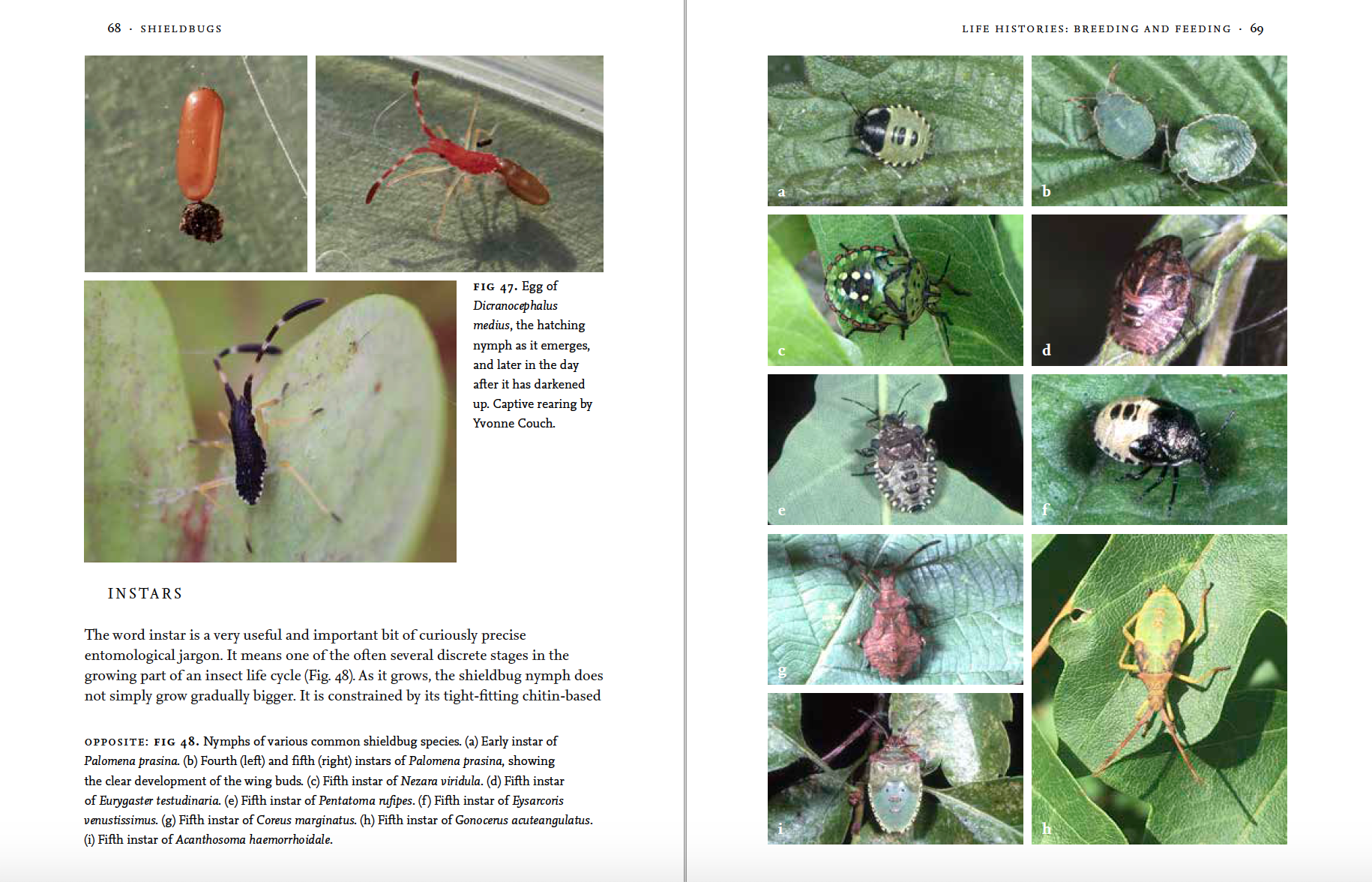
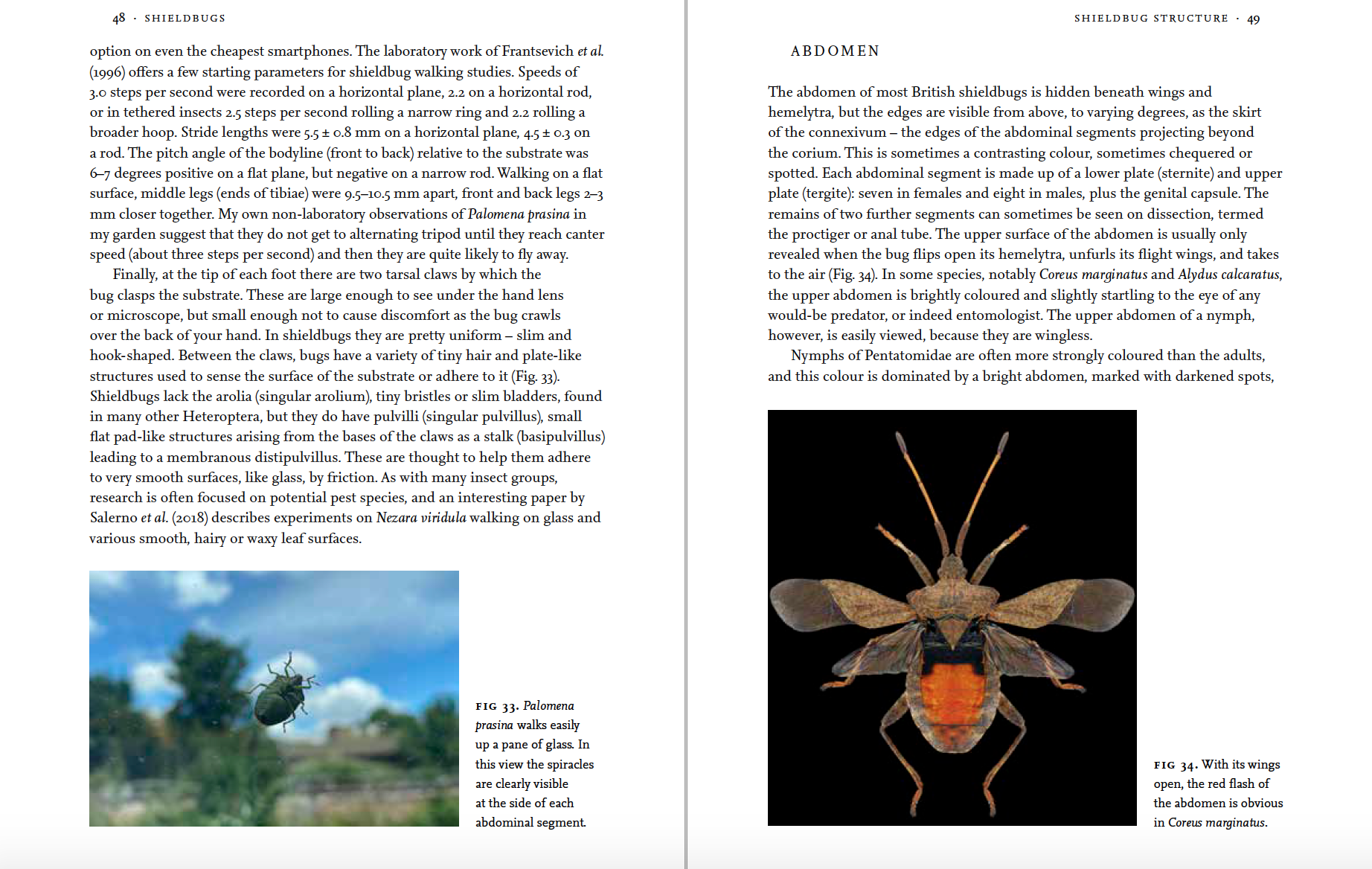
Shieldbugs is, apparently, due out in July. Here are a few random sample pages.

Today’s favourite beetle

There is no mistaking the inky blue-black domed form of Timarcha tenebricosa — the bloody nose beetle. I let out a little squeal of joy when the 17-year-old bent down and scooped this up from the grass at the edge of the track through Chysauster Ancient Village, Cornwall, a couple of days ago.

This is an insect from my childhood, and no walk over the Sussex South Downs (literally out the door and up the hill) was complete unless we’d found one of them bumbling through the herbage. Occasionally we’d find the equally inky blue-black and slightly oily-looking larvae feeding on goose grass or bedstraw, and more than once we took some home to rear through to adulthood.

The first time I picked one up, slightly roughly as a 6-year-old I guess, it exuded so much red liquor that I half thought it was my own blood, and that the beast had bitten me. That startle factor may well have been part of its defensive ploy — together with the bitter taste, which I did not try until much later in my life.

So much part of our lives were these insects that one even featured in the bedtime stories my Dad told us; along with Willie Stag Beetle, his wife Agatha, and Leggyleg the centipede, Ermintrude Squiggle was often called upon to write some secret message using her own bright red blood. Yes, I know that sounds rather gothic now, but these were just everyday tales of insect folk, for us, back in the day.

We were very gentle with Mr Squiggle (large broad front feet = male) at Chysauster and no haemolymph was spilled or secreted. After much admiration and some publicity stills he was sent waddling his clockwork way off through the flowery sward.

I don’t collect stamps but …

In 1962 the world’s postal services (not the UK’s Royal Mail though!) supported the United Nations ‘World United Against Malaria‘ campaign — a concerted effort to focus attention and funds onto a disease killing half a million people a year in some of the world’s poorest countries. Stamp producers came back with a wealth of eye-catching designs.

Italy’s showed lauded malaria researcher Giovanni Battista Grassi, who along with Britain’s Ronald Ross isolated the blood parasite from mosquitoes. The Cuban three showed the Plasmodium parasites under the microscope, the mosquito vector and chemical quinine. Kenya’s, rather disturbingly, showed a malaria victim looking very ill, with a horrid halo of the malaria infection cycle around his head. Mali’s were the brightest, showing a series of informative tableaux for the benefit of the malaria-stricken letter-senders of the country. On a lighter note, the Vanuatu series depicted a horse-rider (fund-raising charity races), an aeroplane (‘on a mercy mission’), a bright new ambulance, and a ‘mosquito-eradicated’ sign. Hidden among the stamp designs is the occasional error of printing so highly valued by collectors. On the green 100f from Republique de Guinée a few were printed with the black mosquito upside down.

I finally came across one on eBay. More than the 50p the original ‘correct’ printing cost me, but still only a few pounds.

The legs-up death pose makes a silent, optimistic and very moving statement.

It’s my standard line — “I did a survey there”

It’s become a bit of a clichéed joke in my family that whenever we’re out and about I can point casually out of the car window and claim “I’ve done a survey there, you know”. Part of the reason for the hiatus in this blog is that I have been busy out on field survey visits since April. This year I found myself at a site that I had not surveyed before, nevertheless, I knew of the place, in a reverse sort of way, from almost forgotten family history.

Travelling by train to Hampton Court Station to visit nearby Hurst Park, I see from the map that this block of land, next to the Thames, opposite Hampton Court Palace is called Cigarette Island, named, so the interpretation boards tell, after a large and impressive houseboat so called, which used to be moored here. I know that boat. My Dad used to live aboard.

Dad was always rather quiet about his past. He wasn’t one to regale us with tales of when he was a boy. I knew he’d lived on a houseboat at one point, but the exact details were sketchy until he wrote a short autobiography — a prelude to an explanation of his botanical records, diaries and notebooks which were to go to the Library of the Natural History Museum on his death. It was in this brief document that he described and named the boat.

“My mother was Henriette Lucy Jones neé Luxton who came from Yorkshire and my father Reginald Bernard Jones described as ‘blacksmith (journeyman)’ on my birth certificate, although as this was the time of the slump I gathered he did any jobs he could find. We were poorly off and at one stage my father, mother and I lived on a long houseboat called The Cigarette described as ‘Dr Walford Bodie’s Floating Palace Houseboat, The Lawns, Thames Ditton, Surrey (opposite Hampton Court Palace)’ on a post-card that I have.”

“My father was in some way a caretaker on board whilst it was empty, presumably temporarily. It had, as far as I can remember, kitchen, dining room, about five bedrooms and a long lounge/ conservatory and had bridges connecting it to the land at each end. Unfortunately this was my father’s undoing for in March 1934 he went out on the ledge that went all the way round the houseboat to get a loaf out of the River Thames with a broom for the swans and must have fallen in. I gave the alarm (at the age of four and a half) “Daddy’s in the water”. He drowned.”

“My sister was born two days later. From then onwards we were even poorer, with my mother going out to do office cleaning, supplemented by a government widow’s pension of 18 shillings a week. Sometimes we lived in one room (three of us, always in London). I looked after myself from the age of 6, with a front-door key. I think someone looked after my sister. They were hard times, but we knew no other.”

Apparently The Cigarette, was originally owned by Sir Henry Foreman (1852-1924), Member of Parliament and Mayor of Hammersmith. According to the Molesey History Society website, it and the other boats were given notice to quit in October 1931 and this is presumably when it took up its new mooring a few hundred metres away downriver at The Lawns in Thames Ditton. When he was alive my father never mentioned Walford Bodie (1869-1939), but the inernet is awash with his exploits as celebrity, showman, hypnotist, entrepreneur, and quack doctor who mock-electrocuted people on stage and made all sorts of medicinal claims about his galvanizing ‘treatment’. According to the Wikipedia entry on Bodie, his houseboat was actually called La Belle Electra, a name also used by his glamorous onstage assistant, who may or may not have been his sister-in-law. Who knows, maybe the boats were one and the same, renamed under new ownership?

Today there are still expensive houseboats on the River, but these are a kilometre further upstream opposite Hurst Park. I cannot find the post-card Dad mentions but have a vague memory of a black and white image of a vessel something like a smaller version of the Mississippi paddle steamers you sometimes see in westerns. Today The Lawns offer gentle views across the River Thames to Hampton Court Palace. A place of quiet reflection, to contemplate times gone, things half remembered, and people never met.

I’m not the only one finger-tip searching

On a bright and sunny 9 June 2004, I left London down the A2, exited through Strood, across the Rochester Bridge, and turned sharp left into the bluntly named Gas House Road. Parking near the gas storage holders, I emerged from the car to find, not the rolling Kent countryside, but a post-industrial landscape of derelict warehouses, disintegrating riverside wharfs, and piles of bulldozed rubble. Acres of old tarmac lay crumbling beneath broken street lights and straggly bramble bushes; there were several burnt-out cars, and fly-tipping by the lorry-load had been carried out on a criminal scale. A perfect place to look for insects.

This may not be everyone’s idea of prime habitat, but the brownfields of South Essex and North Kent, now grandly titled the Thames Gateway, have revealed many invertebrate wildlife wonders over the last 25 years. The crushed brick and concrete from buildings demolished long ago has become mingled with a meagre topsoil, and nature has taken back what was once her own. It’s hot and well-drained, but sparse vegetation sprouts, just enough to give a delicious softening green haze to the harsh edges of half-buried foundations and crumbling walls.

Rochester Castle overlooks prime wildlife habitat as far as I’m concerned.

Brownfields are poorly named — this, like many, was a riot of colour as sea aster, ox-eye daisy, yellow hawkbit, bristly ox-tongue and yarrow flowers vied for my attention. And with the wild flowers, more diverse than on ancient chalk downland, come the insects: this is why I was here.

Anticipation was high, and my excitement was soon justified. A green hairstreak, living up to its name, dashed past at full pelt over a sunlit corner of bramble flowers, and a six-belted clearwing moth flitted by soon after. The tiny round yellow fly, Gymonsoma nitens, was visiting the white flowers of wild carrot. A parasite of shieldbugs, it was thought to be virtually extinct in Britain until it was found in the Gateway — it’s now a regular.

Brownfields are particularly good for ground beetles; they thrive on the hot sunny ground. I soon adopted the standard entomological pose — head down, bum in the air, scrabbling with my fingers in the crumbly root-thatch and loose soil. This being an official environmental survey I decided to put in some pitfall traps for them — plastic disposable cups, tops set in flush to the ground to catch whatever might fall in. Unfortunately, the broken rubble was completely defeating my garden trowel. Undeterred, I started to use my sheath knife, the one with the stout 20-cm blade. On my knees, using bone-jarring double-handed stabs into the hard ground I was making some headway when I noticed I was being watched by a smartly dressed man carrying a clip-board.

Not the knife I use to cut the apple in my packed lunch.

I stopped and looked up, thinking he must be a planner or engineer connected to the proposed redevelopment of the site. He introduced himself: he was a police detective. A body had recently been hauled from the River Medway nearby, those uniformed men over there were the finger-tip search team examining the area where the sawn-off shotgun had been found, and I was in the middle of a murder enquiry.

The Rochester Police search line.

Trying not to look too guiltily at the large Bowie knife in my hands, I explained what I was doing. He was mildly interested, but unconcerned. Maybe, though, I could keep a look out, during my own hands-and-knees searches, for anything that might be helpful to their enquiries. I unhesitatingly agreed.

Needless to say, I spent the rest of my time in Rochester in a state of heightened wariness. Now I can make light of it, but I’m still thankful I didn’t find anything more suspicious than a drift of bee orchids and a nationally scarce tortoise bug. Oh, and there were several interesting ground beetles.