Category Archives: General Stuff

Not a powerpoint presentation in sight

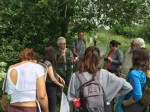
Last Friday saw me at London Wildlife Trust’s newest reserve at Woodberry Wetlands, off the Seven Sisters Road in North London, giving a workshop grandly entitled: Identifying butterflies, moths and invertebrates. So just all insects then.

Like other conservation organizations, London Wildlife Trust can get great exposure, and some extra funding, by offering events like this to a fee-paying public. But just how to pitch the vast and complex world of entomology to 10 strangers with little or no expert knowledge of the natural world? My dilemma was compounded by the fact that I’d be getting there by public transport, travelling through central London in the rush hour, and trekking from Manor House Tube on foot.

Actually, that more or less sorted it — travel light. So in the spirit of less is more I was able to follow my usual path of avoiding powerpoint presentations and concentrated on waving my arms about, then waving a net.

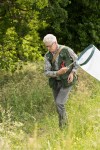
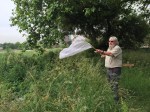
There was arm and net waving from the very beginning.

There was arm and net waving from the very beginning.

One of the delights of entomology is that anyone can study insects with a minimum of equipment, and with immediate success. We were armed with rudimentary sweep nets and beating trays and an assortment of plastic tubes and bottles. As usual, it was all very Heath-Robinson.
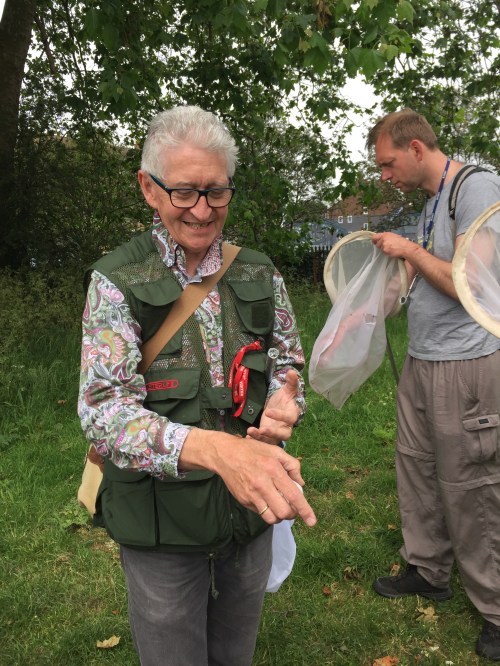
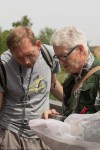
Just look at the childish glee on that face, and yet I've seen it all before.

Just look at the childish glee on that face, and yet I’m the one who’s seen it all before.

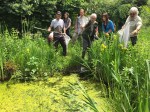
This, then, was my message, delivered with a smirk and an exuberant shirt: the only equipment you need is your eyes. We went off with no expectations and no prior knowledge of the site to see what would turn up, and to try and fit that into how insects are classified, how we might tell them apart, and how even a beginner can contribute through the multifarious tendrils of citizen science.

Woodberry being a lake, almost the first insect we found was the water ladybird, Anisoticta novemdecimpunctata, and the record was uploaded to the UK Ladybird Survey within minutes. Job done. This was shortly followed by the smaller  Coccidula scutellata, another reed-bed ladybird.

During our circuit of the reservoir we found plenty to occupy us, and a list of species has been supplied to the trust. We finished off back at the classroom where I quickly set a couple of flies to have a look at under the microscope.

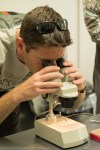
All you need is a basic (and cheap) stereomicroscope with low power, nothing fancy.

All you need is a basic (and cheap) stereomicroscope with low power, nothing fancy.

I’ve already come up with my own short list of introductory identification guides, it might need a bit of updating occasionally. This is the one that stands out at the top:

Full of superb pictures and concise clear text, you can see how much wear my copy has had.

Full of superb pictures and concise clear text, you can see how much wear my paperback copy has had.

All in all, an enjoyable day for me, to be able to chat about and demonstrate even quite common insects to an enthusiastic party. More in the future I hope. Thanks to Penny Dixie, a volunteer at the reserve, for taking so many photos. Here is another selection:


It may be indoors, but it’s not a household creature

I was brought this yesterday. A couple appeared at the Nunhead Cemetery Open Day bug-hunt and when there was a gap in the stream of children they leant in and handed me a small plastic pot containing a longhorn beetle — Phymatodes testaceus.

Phymatodes testaceus is sometimes testaceous (reddish) sometimes metallic blue, sometimes both, but always striking.

Phymatodes testaceus is sometimes testaceous (reddish) sometimes metallic blue, sometimes both, but always striking.

It’s a beetle I don’t see very often, and although widespread in most of England and Wales I’d consider it very local. Where had it come from? Their Kent living room — quite a few of them apparently, flying about over the last few days. They were slightly worried in case there was an infestation. They could tell from my sceptical expression that this was unlikely.

There is no way that this is a domestic insect, it’s a species of old broad-leaved woodlands, breeding in the dead logs that litter the woods. Ah! A look of understanding crossed their brows. They must have been in the logs — brought in during the winter for the log-burning stove. Sorted.

They went away well pleased, but declined a bug-hunt certificate.

Acting in a suspicious manner is all in a day’s work

I couldn’t imagine anything more mundane. Verity and I had been out for a walk in Bostall Heath Woods (Greenwich), and as we were walking back to the car, along the scrubby overgrown verge of the A206 I saw a broken road sign lying in the long grass — it was just asking to be turned over. Over it went to reveal an ant nest (complete with larvae), various woodlice and some spiders. Nothing out of the ordinary, but you never know. See a log, roll it over. It’s a mantra that the curious entomologist utters; and for the sake of ecological completeness, ‘log’ can also mean plank of wood, sheet of MDF, broken fence panel, old mattress, discarded clothing, rubbish, litter or a broken road sign.

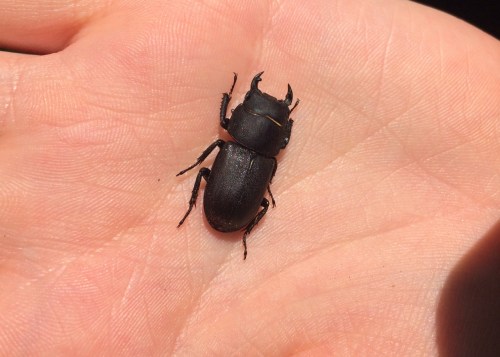
Here's one we found earlier — the lesser stag, Dorcus. Charming, chunky and chewing it's way through a log.

Here’s one we found earlier — the lesser stag, Dorcus. Charming, chunky and chewing it’s way through a log.

All manner of things can turn up. Earlier that day we’d found a lesser stag beetle, Dorcus parallelipipedus, and the largest pill millipedes (Glomeris) I’ve ever seen. That there was nothing of great note under the road sign was of no matter. I will turn over the next log, or rejectamenta, with keen anticipation and I’m sure there will be treasures beneath.

We regained the verge and continued walking, whilst wondering what the plonker in the silver Ford Focus was doing, reversing down the other side of the busy A road towards us. It was only when he came level with us that the Metropolitan Police sign on the door became visible. He wound down the window and called out. He’d seen us veer off the roadside and crouch down in the thick herbage, and ‘wondered if we were alright’. In other words, he’d seen some unusual behaviour and was checking us out.

I immediately turned into my Dad and adopting my best cheery Radio 4 voice announced that I was looking for insects. It just came out like that. I couldn’t stop myself. I could have added “…my good man” and I wouldn’t have been stepping out of character.

Seemingly he bought it, shouted something along the lines of “well, enjoy the rest of your day”, and drove off.

Could things have gone differently? I’m reminded of the tale, most likely apocryphal, of the Reverend Edmund James Pearce (1903–1982), a renowned coleopterist specializing in the tiny rove beetles Pselaphidae. He was apt to be a bit absent-minded, and was once found excitedly flapping about in his cassock somewhere deep in the moors having just discovered some tiny insect of great note — probably under a ‘log’. Unfortunately, the police who found him were supposedly in pursuit of a madman, who had escaped from an asylum dressed as a clergyman.

There was no holding cell for me today. My cover is still intact.

Call of nature — the secret life of dung

We have a cover concept, and a title. And I’m very pleased to see that the spine of the book will be adorned with an elephant’s bottom. Publication, some time in October I think.

Elephant trumpeting = calling; there's a visual pun thing going on here too.

Elephant trumpeting = calling; there’s a visual pun thing going on here too.

From chapter 13, Glossary: Call of nature, idiomatic expression of a general need to urinate or defecate. The only euphemism I will allow myself, but only if accompanied by the natural act itself, somewhere out in nature.

Well, I’m calling it the woodhopper

Not a woodlouse, but Arcitalitrus dorrieni, Britain’s only terrestrial amphipod. A native of Eastern Australia, it was first found in the UK, in the Isles of Scilly in 1924, and has been spreading across the West Country ever since. I found it in Battersea Park some years ago, but these were found in Nunhead Cemetery earlier this afternoon.

The first click is the loudest

Between Friston Forest and the cliff-tops of the Seven Sisters is a rolling chalk downland of arable fields, hedges and grazing meadows, and when my family first moved down to Newhaven, in 1965, it was an easy bus journey away for a ramble in the countryside. It was here, I must have been about 10, so perhaps 1968, that I was ambling along behind everyone else examining the contents of my sweepnet, when I saw a large (15 mm) long, narrow, brown beetle at the bottom of the bag. I picked it up and was immediately jolted by its violent twanging in my fingers.

Humans are born coleopterists, otherwise why would we have such perfectly cushioned pads on finger and thumb to hold beetles gently but firmly in place? I held it there, softly, but it kept pinging away. I put it up to my ear to listen to the crisp clicking sound. Wow. I realized that this was something terribly exciting, so off I ran to show my find to Mum and Dad.

My father immediately recognized it as a click beetle; from memory it was probably the exceedingly common Athous haemorrhoidalis. The power of the jack-knifing beetle was amazing, and of course it was all the more impressive to see one flip right up into the air, spinning wildly, in its escape bid, a superb predator-avoidance tactic.

The clicking noise is highly reminiscent of the deathwatch tick. My father later told of the occasion he was sitting quietly at home when he suddenly became aware of a soft clicking noise, repeated erratically, but insistently from somewhere over in the corner of the room. Deathwatch beetles only occur in old buildings where massive hardwood beams and joists were already infested when the building was erected centuries before. Though they feed slowly and laboriously, scores of generations later they have hollowed out large voids, enough to seriously weaken the structural integrity of the woodwork, with sometimes catastrophic results. Our 1930s Newhaven house seemed a highly dubious locality, so what was this?

On hands and knees he started investigating the dusty corners of the bookcase and the underside of the armchair. Nothing. It seemed to be coming from the unlikely piece of spindly display shelf furniture referred to as the whatnot. Well, it was made of wood, but there was so little of it that a colony of deathwatch seemed implausible. The noise was definitely coming from underneath the bottom whatnot shelf, and gently tipping the thing on its side revealed a small grey lump of something dangling by a thread.

It was a click beetle, caught in the web of a house spider. It was still alive, barely, and despite its seemingly hopeless predicament, its flicking, jolting, predator defence mechanism had kicked it. It was struggling, flexing ineffectually, to escape the bonds of an undesirable fate. Another entry in the book of family legend.

I never pick up Athous haemorrhoidalis now, it’s probably Britain’s commonest click, and pretty easily named in the field, either on a flower, or at the bottom of the sweep net. Next time, though, I’m going to hold it gently but firmly, between opposable forefinger and thumb pads, and hold it up to my ear, to revisit that memory of a summer long ago.

My head just grew two sizes bigger

CbF0P9gW0AAd6Fw.jpg-large

The young paperbacks are released out into the wild.


If it wasn’t enough that m’latest book has appeared in paperback, then the book review in the Guardian was the icing on the cake. What can I say? I am scarlet with smug embarrassment.


Screen Shot 2016-02-26 at 22.11.19

I keep going back to check that it really is a review of my book.


Dung — what could be more natural?

Dung — a natural history is almost there. The typescript has been delivered to the publishers. We have a cover concept. We have most of the illustrations. Finding pictures to illustrate the book has been fun. There will be an identification guide to dung users; mostly beetles and flies, but a fair few oddities in there too. And there will be a field guide to the dung parcels themselves. I’m not a very good artist, but after sketching quite a number of animals’ pellets and deposits, I now regard myself king of the stipple. Verity has come to the rescue on some of the more challenging pats — those with more subtle sheens and textures. She has also painted some of the more obscure dung beetles.

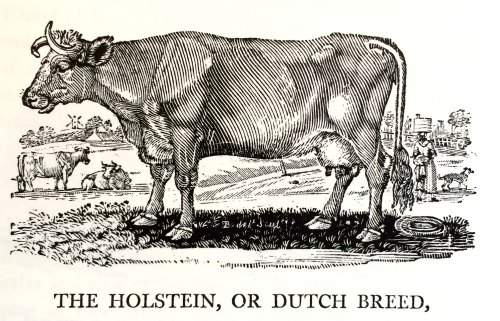
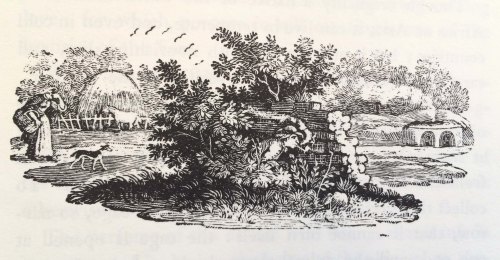
Most of the pictures I have been able to find in old books. These are often exquisite engravings, perfect for the job, but out of copyright — so free to use. And it was whilst I was leafing through Bewick’s A general history of quadrupeds (originally published 1790) that I came across these superb illustrations.

IMG_3380

A fine cow and obligatory pat.

IMG_3374

When was the last time you saw a picture of a defaecating dog in a children’s book?

IMG_3378

Yes, A general history of quadrupeds was intended as a book for children.

There can be no doubt what this chap’s up to. The smoke from the charcoal oven and from his pipe clearly indicates which way the wind is blowing. And the woman is not holding her hat on against the wind, she is quite clearly holding her nose.

And, in case you’re interested, that means the dung beetles will soon fly in from stage left too, flying up-wind into the plume of volatiles which include tasty signals like skatole, phenol and 2-butanone.

The curious incident of the dung beetle in the night-time

My father made eye contact and said something along the lines: “Can you hear that?” To start I wasn’t sure whether he meant Radio 4 droning away in the corner of the room, my brother careening down the stairs, or the kettle whistling on the gas in the kitchen. No, he was referring to an almost inaudible tick, tick, tick, coming from the window. He had the knowing look of someone who is about to show off something new.

As a 10-year-old, it was not unusual for me to be sitting in the lounge, as we called my father’s book-lined sitting room. Whilst he sat in the centre of the room behind the large polished wooden desk strewn with pens, papers and books, perhaps a microscope and a drawer of insects, I’d be perched at the smaller bureau-style table against the wall. Maybe I’d be doing homework. Actually, I’m not sure 10-year-olds had homework then. More likely I’d be writing up my own nature diary from whatever family trek we’d been out on that day. I might even have been pinning my own insect specimens, or doodling a sketch of a plant, or a map.

The tapping was definitely coming from outside the window. We drew back the curtains, but the brightly lit aura of the room barely penetrated the dark outside. There was nothing I could see. My Dad knew better. Slipping on shoes we tripped round to the front of the house to see what was going on.

The noise had stopped when we got to the window, but Dad pointed to the windowsill, probably just at or above the level of my eyeline. There, crawling across the yellow paintwork was a beetle.

Medium-sized (12 mm), elongate, parallel-sided, subcylindrical, dark brown nearly black, it had shortish stout legs and strongly clubbed antennae. Aphodius rufipes was my first dung beetle. It had flown in from the flood-plain grazing meadows that flanked the River Ouse hereabouts. Many hundreds of metres probably. Quite an achievement for a half-inch insect.

Aphodius Reitter 3 copy

Some handsome dung beetles. Aphodius rufipes is top right.

I strain now, but I can’t quite remember whether I thought this an odd thing for a beetle. Maybe the notion of dung recycling had already crossed my radar. I certainly understood about stag beetle larvae living in rotten wood. I probably knew about drone flies breeding in flooded tree holes. It’s all decaying organic matter.

It wouldn’t be long before Dad would also show me the huge dumbledors, Geotrupes spinipes, or maybe it was stercorarius, heaving its juggernaut way through the fingers of my clasped hand, then flying off, like a miniature helicopter. The power of the toothed legs amazed me, and the feeling of that downdraft as it buzzed away stays with me still.

Dissecting a cow pat came naturally to me. Other dung beetles followed. The great glossy Aphodius fossor, slightly shorter, but thicker and heavier than rufipes, was a favourite, so too was the small mottled and rather rare Aphodius paykulli. The chunky earthmover shape of Onthophagus coenobita appeared when I graduated to dog dung, and the mythically horned Minotaur beetle, Typhoeus typhaeus was eventually dug up from under rabbit crottels in Ashdown Forest.

I still find Aphodius rufipes occasionally. In cow or horse droppings. Never at my lighted window though. But whenever I hold its  smooth elegant shape in my fingers, I still think back to the warm summer Newhaven evenings, and the delicate head banging on the lounge glass.