Category Archives: Surveys

Me and my rocket-launcher

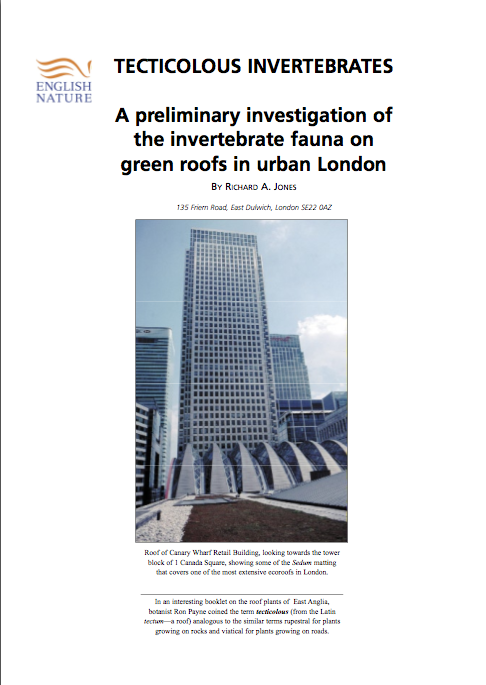
Ten years ago I was asked by English Nature to survey some of London’s newfangled ‘green’ roofs, to see whether they really were good for wildlife. I was really quite chuffed to be asked, it was a prestigious piece of work.

Egged on by the supporters of German and Swiss planning laws, having a living roof on top of new buildings was increasingly seen as a way of mitigating for any wildlife loss from the flowery, but often ugly, brownfield sites as they were developed. This was good for the developers, who could claim environmental credentials, good for the planners, who could claim environmental commitment, but was it good for the insects?

I took to the rooftops to find out. Most of the roofs were small, a couple of private houses, the visitor centre of the Mile End Cemetery Park, and a community centre on Gray’s Inn Road. But one series were huge — on several of the office blocks at Canary Wharf. These were also the most difficult to survey. Unlike some of the smaller buildings, which had soil/gravel mixtures and which produced a lush flowery growth to attack with a sweep-net, those at Canary Wharf were covered with a low carpet of drought-hardy Sedums, the stonecrops you might have found on slightly old-fashioned rock gardens.

Sedum at Canary Wharf, a red/green carpet for the delight of office workers looking down from above.

Carpet is the right word. Huge mats of spongy rubber, a bit like those used in the gym, were impregnated with Sedum seeds, then grown out of doors. When required, they were rolled up, delivered on site in giant rolls and cut to fit just like someone carpeting the lounge.

From the offices above, they presented a red/green pattern against the concrete, steel and glass. But they were only a few centimetres thick. My sweep-net was set aside, what I needed here was something a bit more high-tech. The B&Q on the Greenwich Peninsula provided the answer — a two-stroke garden blower-vac.

Fixing a stout canvas bag into the intake nozzle, I could use it like a giant hoover, sucking up any bugs from the short sward, then turning it off and emptying the bag contents onto a plastic sheet. It worked well, and I found plenty of odd and unusual things. My draft report is here.

There was, however, always something on my mind. Here was I, in a major financial district of the capital, in the shadow of some of Britain’s tallest buildings, a few months after the World Trade Center attacks, carrying something that looked like a rocket launcher.

Hoovering the roof.

I don’t know how many people noticed me out of the windows of 1 Canada Square, but I’m extremely thankful I was never confronted by the anti-terrorist squad.
The search for Britain’s rarest beetle

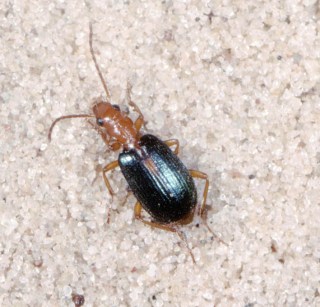
Monday 9th January 2012 and the first field visit of the year — in search of Britain’s rarest beetle, Brachinus sclopeta. At about 6 mm long, the streaked bombardier beetle is hardly going to cause many heads to turn, but is a charismatic and pretty little thing. When I turned over a square of roofing felt on a derelict site near the Thames Barrier in June 2005, and one scurried away under the bright sun, my heart soared. Instantly recognizable, painfully beautiful and mythically rare, this was my equivalent of what Simon Barnes brilliantly described in How to be a Bad Birdwatcher, as his avocet moment.

Although immediately identifiable because of its pretty colours and markings, very little was known about this insect’s occurrence in Britain. It was always reported in the old beetle monographs as “doubtfully British”, “said to have been captured” or “reputed to have been taken”. Like it was a unicorn or something. It might have been found in Devon. Or Norfolk. Who knows. In an almost comical example of the parlous state of early 19th century invertebrate recording, J.F. Stephens, one of the founding fathers of British entomology, wrote of the single specimen in his huge collection “I rather think mine came from Hastings”. Pathetic really.

The last vaguely reliable sightings were probably from Southend (Essex) in about 1820, and Margate (Kent) in 1830. For 150 years it remained a fascinating, but enigmatic insect, until an old specimen was unearthed in the National Museums of Wales in 1985, labelled ‘Beachy Head, 1928’. This is likely to have been the last time this beetle was seen alive in the British Isles.

But in 2005, there they were, dozens of them, amidst piles of bulldozed rubble and twisted metal, on a most unprepossessing brownfield site, long derelict and abandoned. Ordinarily such a find might raise the spirits. Brownfield sites are often alive with strange and unusual insects, including many nationally scarce and even red data book species. But, as ever, the shadow of destruction loomed; the site was due for imminent development — more luxury flats with a river view.

The site is now razed, crane gantries tower over it and the first rather brutal-looking department blocks have been built. But the beetle might still be hanging on. Because, believe it or not, this is perhaps the smallest nature reserve in the country, just for a beetle:

Britain’s smallest (and ugliest?) nature reserve.

Before the land was cleared, the developers were cajoled into creating a mound of the same bulldozed rubble, crushed brick and concrete with a bit of topsoil, in which the beetles were living. They even fenced it off. There is no interpretation board though.

It’s just an overgrown heap of rubble.

Then, on Friday 5th October 2007 assorted volunteers and eco-oddbods met to try and mount a beetle translocation. Finger-tip searching in the scratchy concrete-impregnated root-thatch of the donor site eventually yielded 61 specimens of B. sclopeta. They were identified, counted, checked, photographed, lovingly handled, then duly released, like Elsa the lion, back into the wild. It made headline news. I wrote a short piece for London Wildlife Trust’s Wild London (scroll down to page 13).

The mound remains today, though looking rather sad behind its cluttered fence and in the mounting shadow of the building developments all around. It will need the occasional cut to prevent the herbage getting too dank and dense. And, amazingly, the beetle was still there in May 2010 when I shinned over the chainlink to have a quick look. I was relieved to dismiss the cynic in me, which sometimes wondered if our ‘translocation’ had really been an ‘eradication’.

Now move on to 9 January 2012 and I am back again, to see what is going on. Because things are happening to Brachinus sclopeta. It has been found at another site. Just across the A1020 North Woolwich Road, the similarly derelict Silvertown Quays are to be developed. And, guess what, the streaked bombardier is living in another mound of bulldozed rubble less than 250 metres from where I found it 7 years ago.

It looks like the right sort of rubble heap.

So translocation is in everyone’s mind again. Perhaps some mounds of bulldozed spoil can be sculpted into a series of rough tumuli, or maybe longbarrows. They will have to be out of public view and out of reach, they are …<hushed tones>…contaminated, with heavy metals. I’m sure the beetle doesn’t mind.

Arguably, Brachinus sclopeta, may not yet qualify as Britain’s rarest beetle. It has, after all, been actually found recently. There are plenty of others that are still missing for years, presumed extinct. But, though I ripped my finger-tips raw in the sharp brick dust and crushed concrete, on both sides of the A1020 yesterday, I could not find it. I worry we don’t have much time. Work is due to start on the site in a few weeks. This population of streaked bombardiers may yet be eradicated. Watch this space.