Our Lego giraffe-necked weevil is a triumph

Buoyed up by the previous success of of our Lego head louse, 6-year-old and I have been working on some other insect constructions. The kitchen table could barely hold the mountain of bricks and the cats occasionally got out of hand skittering small bits under the fridge or behind the bin. I had to rescue Hagrid’s hair and beard from the mouth of the black one, and it is now rather unpleasantly slimy. Luckily, I don’t think that particular Lego piece will ever be needed for one of our entomological masterpieces. And, although I say it myself, masterpieces they are.

I wanted to do an earwig. I’m quite pleased with the result, but as my assistant pointed out, the yellow is a bit jarring on the eye. Lego need to commission a series of more insect-based chitinous colours; testaceous, ferrugineous and fuscous should do it.

Not much chance of this Forficula auricularia crawling into your ear.

Incidentally, I recently came across this report on ear-invading arthropods, which I thought was quite peculiar. Earwigs are not mentioned though. There is, however, a tale, not apocryphal I believe, that a ‘gentleman of the road’ visited the Natural History Museum in London (must have been back in the 1950s or 1960s maybe) expressly to offer personal testimony to assembled experts that, given the chance, earwigs would indeed invade the ear canal if you slept rough under a hedge.

Anyway, back to Lego. Next, we moved on to the sinister outlines of the death’s-head hawk. Not bad, although the sombre subtlety of the wing mottles do lose something in the translation to Lego pixelification.

For best effect, try squinting at this one.

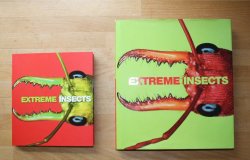
What next? I thought bed-bug, maybe, or dung beetle. But 6-year-old had a better idea. He knew exactly where to go for the image, the Japanese edition of Extreme Insects, which has this wonderful creature on the cover:

Our giraffe-necked weevil is a triumph.

The giraffe-necked weevil, Trachelophorus giraffa, suits everything about Lego: its bright colours, angular shapes and robotic form. If anything, our model looks more life-like than the living insect.

Life is sweet

Even in the bleak post-industrial dereliction of the Thames waterside through North Woolwich and Beckton, life is still sweet. Mr Tate may have given us art galleries of repute, but his partner Mr Lyle gave us a giant tin of golden syrup the size of a Transit Van.

Abram Lyle would be pleased at his architectural legacy. What, I wonder would he have made at the pretence to metrication — by the relabelling of his 2 lb tins as 907 grams?

This is the surreal view from West Silvertown station on the Docklands Light Railway, showing the Tate & Lyle factory, one of the few remaining commercial premises still working in the area. According to the Tate & Lyle website, Abram Lyle started selling off the previously waste syrup created during the sugar refining process in 1883, first in wooden casks to employees, but in tins to the general public from 1885.

If you click on the photo and enlarge it, you can make out the lion and the quotation from Judges (Chapter 14, Verse 14): “…out of the strong came forth sweetness.” This, of course, is the insect link on which I will now dwell. The lion is dead, and the speckles above it are supposed to be honeybees; the story just keeps getting stranger.

The words are spoken by Samson, to some truculent in-laws (‘uncircumcised Philistines’), at his wedding. It is a riddle, on which hangs the wager of Samson receiving 30 bed-sheets and 30 sets of clothes or, if he loses, having to provide them for his guests. He’s remembering some time before when he killed a young lion with his bare hands and, walking past a short while later, he noticed a swarm of bees in the carcass. The full riddle is: “Out of the eater came forth meat, and out of the strong came forth sweetness”. Meat, in that archaic sense of anything edible, was, of course, the honey.

Needless to say, the Philistines had no idea what he was on about, until they convinced his fiancée to wheedle it out of him before the full 7 days of the wedding bet were up. Not best pleased about being answered in so sly a manner, Samson berates them that they only got the answer by ploughing with his heifer wife. An interesting, but rather harsh analogy I thought. He then went off and killed 30 locals, stripping them of their spoil to settle his debt of wager. Grim reading it all makes. I doubt the marriage lasted.

Of course, if an entomologist had been on hand, the whole thing would have been sorted in a trice. The notion of the oxen-born bee, the spontaneous appearance of bees in ox carcasses, prevailed for thousands of years. In Greek mythology Aristaeus was in big trouble with Eurydice’s nymphs; she’d trodden on a snake and been bitten, as she tried to escape his amorous attentions, so the nymphs killed all his bees. He had to appease them by sacrificing four bulls and four heifers. Nine days of putrefaction later, bees miraculously spewed out of the dead animals. Killing a bullock by blocking its mouth and nostrils and bludgeoning it to death, then leaving it to ferment until its bones were softened, was widely accepted as a useful bit of bee husbandry until at least the middle of the 17th century. The blocking of its nose and throat was to prevent the animal’s soul leaving its body — that was destined to enter the resultant bees.

Strange though this thinking may seem to modern minds, there is an element of potential true observation in what was supposedly being reported. If an animal carcass if left to rot, it attracts the usual swathe of carrion insects. Blowflies and burying beetles come early, but when it gets to the semi-liquid putrefaction stage it attracts a hoverfly.

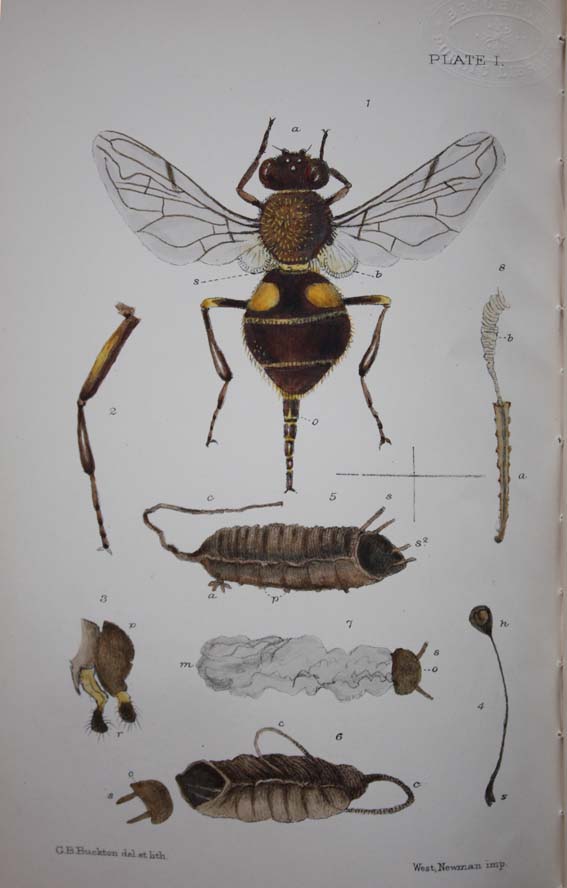
Adult and early stages of Eristalis tenax, plate 1 from 'The natural history of Eristalis tenax or the drone fly' by George Bowdler Buckton, 1895.

Eristalis tenax is a large brown and orange hoverfly; in English it is the drone-fly, so called because of its close resemblance to a male honeybee, a drone (larger eyes than the colony’s female workers). Eristalis  normally lays its eggs in the rotting soup of dead leaves in hedgerow ditches, farmyard drains fouled by animal sewage run-off, and the stinking mud of stagnant woodland pools. And it will, on occasion, also oviposit in the rank gelatinous slime of putrescent meat. Its rat-tailed maggots get their name from the long tail-like breathing siphon on the rear end, which they use to take draughts of air from the water surface whilst they are nibbling their way through the smelly gloop at the bottom of the mirk. This, it turns out, is the oxen-born ‘bee’.

Quite what Abram Lyle was thinking when he designed or commissioned his famous tins is now rather lost to conjecture. Like many Victorian gentlemen of the time he was reputedly a deeply religious man, and he may have seen it as representing the strength of the Lyle company or brand. Or could it have been a clever marketing ploy? Today he would certainly not have got away with calling his artificially produced sweet golden liquor anything to do with honey, or even be allowed to reproduce that symbol of all things sweet and natural and wholesomely industrious — a honeybee — on the label. Yet his tins still proclaim that biblical honey link, even if the supposed bees are now really flies.

The search for Britain’s rarest beetle

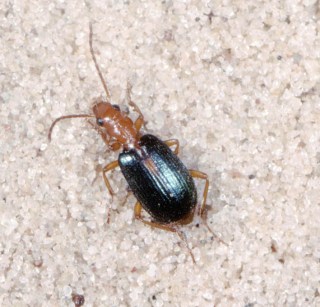
Monday 9th January 2012 and the first field visit of the year — in search of Britain’s rarest beetle, Brachinus sclopeta. At about 6 mm long, the streaked bombardier beetle is hardly going to cause many heads to turn, but is a charismatic and pretty little thing. When I turned over a square of roofing felt on a derelict site near the Thames Barrier in June 2005, and one scurried away under the bright sun, my heart soared. Instantly recognizable, painfully beautiful and mythically rare, this was my equivalent of what Simon Barnes brilliantly described in How to be a Bad Birdwatcher, as his avocet moment.

Although immediately identifiable because of its pretty colours and markings, very little was known about this insect’s occurrence in Britain. It was always reported in the old beetle monographs as “doubtfully British”, “said to have been captured” or “reputed to have been taken”. Like it was a unicorn or something. It might have been found in Devon. Or Norfolk. Who knows. In an almost comical example of the parlous state of early 19th century invertebrate recording, J.F. Stephens, one of the founding fathers of British entomology, wrote of the single specimen in his huge collection “I rather think mine came from Hastings”. Pathetic really.

The last vaguely reliable sightings were probably from Southend (Essex) in about 1820, and Margate (Kent) in 1830. For 150 years it remained a fascinating, but enigmatic insect, until an old specimen was unearthed in the National Museums of Wales in 1985, labelled ‘Beachy Head, 1928’. This is likely to have been the last time this beetle was seen alive in the British Isles.

But in 2005, there they were, dozens of them, amidst piles of bulldozed rubble and twisted metal, on a most unprepossessing brownfield site, long derelict and abandoned. Ordinarily such a find might raise the spirits. Brownfield sites are often alive with strange and unusual insects, including many nationally scarce and even red data book species. But, as ever, the shadow of destruction loomed; the site was due for imminent development — more luxury flats with a river view.

The site is now razed, crane gantries tower over it and the first rather brutal-looking department blocks have been built. But the beetle might still be hanging on. Because, believe it or not, this is perhaps the smallest nature reserve in the country, just for a beetle:

Britain’s smallest (and ugliest?) nature reserve.

Before the land was cleared, the developers were cajoled into creating a mound of the same bulldozed rubble, crushed brick and concrete with a bit of topsoil, in which the beetles were living. They even fenced it off. There is no interpretation board though.

It’s just an overgrown heap of rubble.

Then, on Friday 5th October 2007 assorted volunteers and eco-oddbods met to try and mount a beetle translocation. Finger-tip searching in the scratchy concrete-impregnated root-thatch of the donor site eventually yielded 61 specimens of B. sclopeta. They were identified, counted, checked, photographed, lovingly handled, then duly released, like Elsa the lion, back into the wild. It made headline news. I wrote a short piece for London Wildlife Trust’s Wild London (scroll down to page 13).

The mound remains today, though looking rather sad behind its cluttered fence and in the mounting shadow of the building developments all around. It will need the occasional cut to prevent the herbage getting too dank and dense. And, amazingly, the beetle was still there in May 2010 when I shinned over the chainlink to have a quick look. I was relieved to dismiss the cynic in me, which sometimes wondered if our ‘translocation’ had really been an ‘eradication’.

Now move on to 9 January 2012 and I am back again, to see what is going on. Because things are happening to Brachinus sclopeta. It has been found at another site. Just across the A1020 North Woolwich Road, the similarly derelict Silvertown Quays are to be developed. And, guess what, the streaked bombardier is living in another mound of bulldozed rubble less than 250 metres from where I found it 7 years ago.

It looks like the right sort of rubble heap.

So translocation is in everyone’s mind again. Perhaps some mounds of bulldozed spoil can be sculpted into a series of rough tumuli, or maybe longbarrows. They will have to be out of public view and out of reach, they are …<hushed tones>…contaminated, with heavy metals. I’m sure the beetle doesn’t mind.

Arguably, Brachinus sclopeta, may not yet qualify as Britain’s rarest beetle. It has, after all, been actually found recently. There are plenty of others that are still missing for years, presumed extinct. But, though I ripped my finger-tips raw in the sharp brick dust and crushed concrete, on both sides of the A1020 yesterday, I could not find it. I worry we don’t have much time. Work is due to start on the site in a few weeks. This population of streaked bombardiers may yet be eradicated. Watch this space.

New Year — New Blog

2012 is the Year of the Bug. Well, actually, the last 300 million years have been the year of the bug too.