First published review of ‘Mosquito’

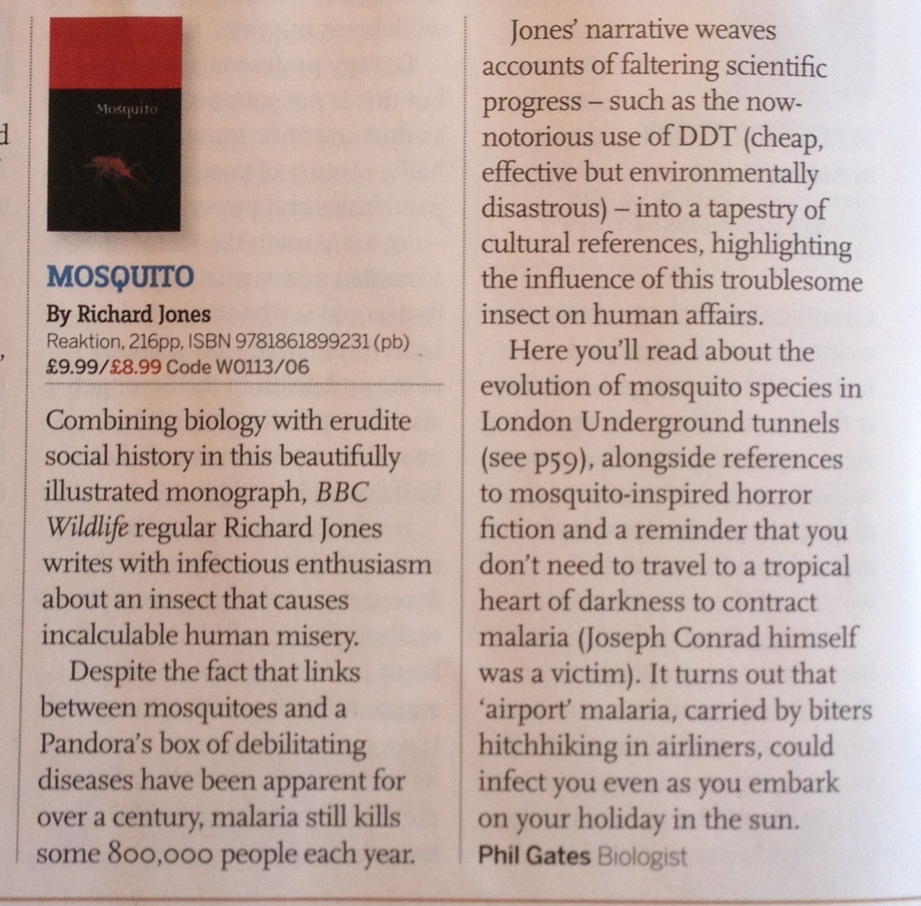
The latest issue of BBC Wildlife dropped through the letterbox this morning, and I’m rather pleased to note that it has a review of ‘Mosquito’ in it.
It’s only short but: “erudite social history”, “infectious enthusiasm”, “a tapestry of cultural references”. I’d like to infer that Dr Gates liked it.

A pest? For how much longer?

The good thing about insect pests is there is just so much written about them. So as I plough through endless books researching House Guests, House Pests, I am constantly distracted by loads of others. Rather poignantly, I came across this one.

The ash borer, Hylesinus fraxini, delightfully pointing out (a) the "mother" galleries.

The ash borer, Hylesinus fraxini, delightfully pointing out (a) the “mother” galleries, from which (b) the larval galleries radiate to (c) the pupal chambers.

This rather lovely plate is from the prosaically titled Report on the injurious insects and other animals observed in the midland counties during 1906 by Walter E. Collinge. This was a time of burgeoning interest in agricultural and forestry insect pests, fuelled by the advent of chemical sprays (notably Paris green, a highly toxic copper acetoarsenite) and the appearance of professional economic entomologists  to advise on pest destruction and yield enhancement.

Although the original image was made as a wood engraving, it has been reproduced by the then modern technique of photo-lithography, giving the background a ghostly pallor.

Even in 1906 I don’t think the ash borer could really have been much of a problem; “three cases of damage to ash trees have been reported upon”. Much more likely, I think, it was the perfect opportunity to insert an attractive plate into the book.

In life, the pretty little beetle is a delicate pinkish grey, mottled by the pattern of small scales covering its wing-cases. It has always been a widespread and common insect, appearing in the sweep net on woodland rides, field edges and road verges wherever their are ash trees about. With the ominous arrival of ash die-back disease, I’m left wondering whether it will go the way of the elm bark beetles, once so common in southern England, but now decidedly scarce, since the destruction of their host trees by Dutch elm disease back in the late 1970s.


At least it’s not called the fag-bug

Lasioderma001

It’s the cigarette beetle, Lasioderma serricorne.

I’ve been doing lots of research into household pests, for the new book on House guests, house pests, so I was excited to discover I’d found another of them myself. OK ‘excited’ might be exaggerating a bit, but there is definitely a sense of satisfied intellectual rigour and achievement on identifying a pale brown 1.75-mm-long beetle that I’ve never seen before.  Working at the microscope through some tiny specimens I’d collected over the year, I came across two specimens that had flown in, attracted to a moth light I’d run, just outside the kitchen door on 28 June 2012.

I should add, for the benefit of any North American readers perplexed by my title, that ‘fag’ is a quaint old British expression for cigarette; this, then, is the cigarette beetle, Lasioderma serricorne.

It supposedly gets its name for its habit of infesting tobacco, whether dried leaves, stored bales, cigars, and especially cigarettes. Related to the domestic woodworm beetle, Anobium punctatum, it will actually feed in a wide range of products including spices, beans, cereals, seeds and cocoa.

Being dull brown, I can only assume that in the days of pipes, cigars and chewing tobacco, this tiny beetle often went unnoticed by the smoker or chewer, much as another close relative the biscuit beetle, Stegobium paniceum, is still overlooked in the kitchen cupboard, unless the occasional struggling insect floats to the surface of the milk poured over infested breakfast cereal. But when  cigarettes started to gain serious popularity in the 1940s, the beetles’ neat round holes in the neat, clean, delicate, white, paper casings started to cause more than mild consternation.

It was during this period that a previously more or less ignored minor pest of such mundane items as ginger and liquorice suddenly acquired its common name. Thankfully, in an era before daft tabloid headlines and media inanity, it was never called the fag-bug.

Memories of a chainman

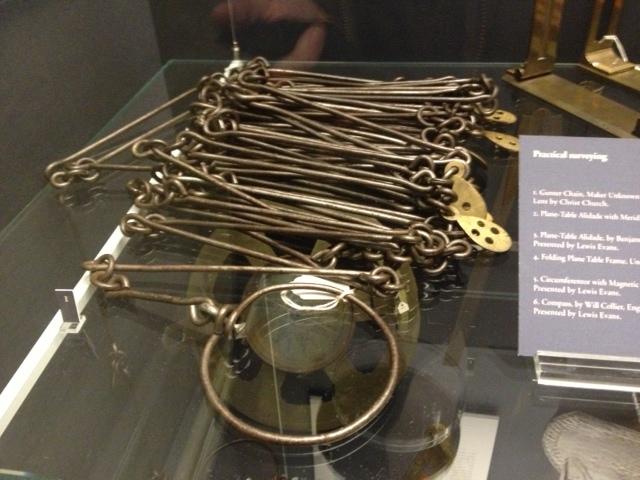
On my recent visit to Oxford, I spent a little time in the Museum of the History of Science, in Broad Street. And amongst all the ancient brass astrolabes, microscopes and alchemical glassware, I was pleased to see a Gunter chain.

My first job after university was working as a chainman on the construction of the Cuilfail Tunnel in Lewes. In an era before steel tape measures, laser-sighting triangulation and GPS, it was the chainman’s job to maintain and haul about the 22 yards of interlinked ironmongery of the Gunter chain. I’d never seen one before, although I had found some pictures in the historical section of one of the surveying basics books lying around in the engineers’ decrepit Portakabin on site.

By the late 1970s a modern chainman’s role involved carting about sighting poles, tripods and levels and setting up theodolites. My biology skills were not needed, but my maths was occasionally put to use in triangulating, or surveying to see if any of the houses above the tunnel had started to subside. They hadn’t.

My lasting memories of the tunnel are the mud, the Portakabin mice, a belligerently fascist South African engineer and the deathwatch beetle which landed on the collar of the site foreman one sunny autumn afternoon.

The best insect on Earth?

Well, this is the Oxford Entomological Society gleefully voting out my suggestion of Wallace’s golden birdwing, Ornithoptera croesus, from their X-Factor “What’s the best insect on Earth” show. Philistines.

I thought I’d done well with my simple premise: Ornithoptera croesus is the most beautiful insect in the world, backed up with that quote from Alfred Russel Wallace; you know the one:

“The beauty and brilliancy of this insect are indescribable, and none but a naturalist can understand the intense excitement I experienced when I at length captured it. On taking it out of my net and opening the glorious wings, my heart began to beat violently, the blood rushed to my head, and I felt much more like fainting than I have done when in apprehension of immediate death. I had a headache the rest of the day, so great was the excitement produced by what will appear to most people a very inadequate cause.”

I also produced the world’s simplest possible Power Point presentation of just one lone slide, and relied on my impassioned rhetoric. But I was defeated.

My competitors were:

Jeremy Thomas, President of the Royal Entomological Society, who proposed the mountain large blue butterfly, Maculinea rebeli, on account of its bizarre and complex life history as a cuckoo parasite in nests of a red ant;

Tim Cockerill, one-time Cambridge Zoologist, and billed on the poster as a ‘flea circus performer’, who espoused the dubious wonder of the human flea, Pulex irritans, and its history as one of the smaller money-making side-shows,

and Jake Snaddon, rainforest ecologist at Oxford’s Biodiversity Institute, who sang the praises of the daringly ocean-going sea-skater, Halobates micans, about which we know, er, virtually nothing actually.

The form of the discussion was to be a balloon debate, where an audience vote dictates which hapless victims are lobbed out of the balloon gondola. I’m afraid to report that birdwing and flea were the first to go. The two remaining finalists, (benefiting perhaps from some hidden Oxford home-ground advantage?) made last-minute pleas before the final vote ejected the sea-skater.

So, there you have it, apparently the best insect in the world is a rather dull blue butterfly with an unlikely and convoluted ecology involving subterranean parasitism and other, less than laudable, grubby behaviours. Harrumph.

But I’m ready for a rematch in 2013, when, rather than something straightforward and elegant, I shall be presenting an obscure nano-beetle with barely understood but obviously bizarre life style. It should be an easy walk-over.

I do quite like the Bug Czar tag, though.

Less is more

At 1.3 millimetres long, Liocyrtusa vittata is less than your average beetle, and tricky to identify even under a microscope, but it’s very scarce.

I’m wondering whether its scarcity has anything to do with its diminutive size. I’m not sure I would have noticed it ‘in the field’ but was able to recognize it as more than a shiny speck of protoplasm when it landed on the old sheet I was using as a backdrop to the mercury vapour moth light I’d lit up on 28 June 2011.

I found a new bug, but it took me 2 years to recognize it

I think it must have been sitting at the edge of my consciousness. I regularly have a clear out of survey specimens. These are the sample voucher specimens collected, but once identified under the microscope, they go off to be used for whatever educational purpose I can throw them to. The last lot went to the Horniman Museum, some might have found their way into the behind-the-scenes reference collections, but most were for use at their hands-on nature base.

Last week, whilst sorting out some insects from past surveys, I noticed the largish shieldbug. It was unnamed. It looked odd. Dredging the depths of memory I vaguely recall thinking it looked a bit unusual when I swept it from the rough brownfield herbage between the railway lines and houses behind Earl’s Court Exhibition Centre in July 2012. At the time I glossed over it as possibly a large pale version of the common hairy shieldbug, Dolycoris baccarum. As usual, I did not have enough time to do anything more than merely set it aside to look at in the dim future. Now, however, pinned beside specimens of Dolycoris, it looked very different.

Imagine, if you will, the sound of assorted gears and cogs grinding, light bulbs pinging on and pennies dropping. Oh! It’s that one.

Rhaphigaster nebulosa, the mottled shieldbug, had been spreading through Europe for the last 20 years when it was first noticed in Rainham Marshes in September 2010. Penny Frith found a breeding colony in Warwick Gardens between Peckham and Camberwell, the following year. What’s really embarrassing is that I went with her to the site to try and find Orientus ishidae, another bug she’d discovered there new to Britain, and she told me all about Rhaphigaster at the time. Her pictures of it are spectacular. I just did not take it in.

I’d better have another trawl through the last few years’ left-overs, to see what else I’ve missed.


What is the collective noun for entomologists?

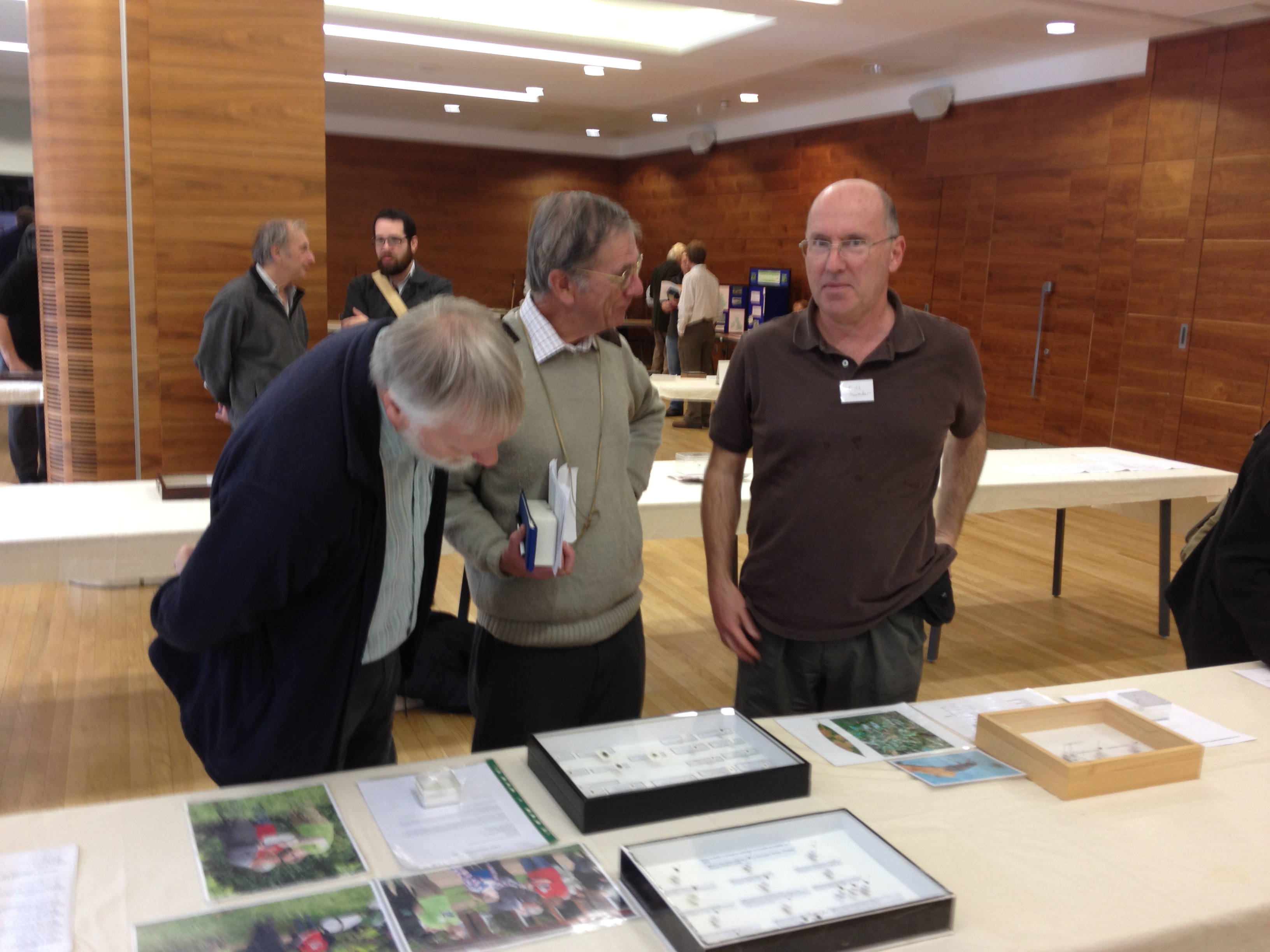
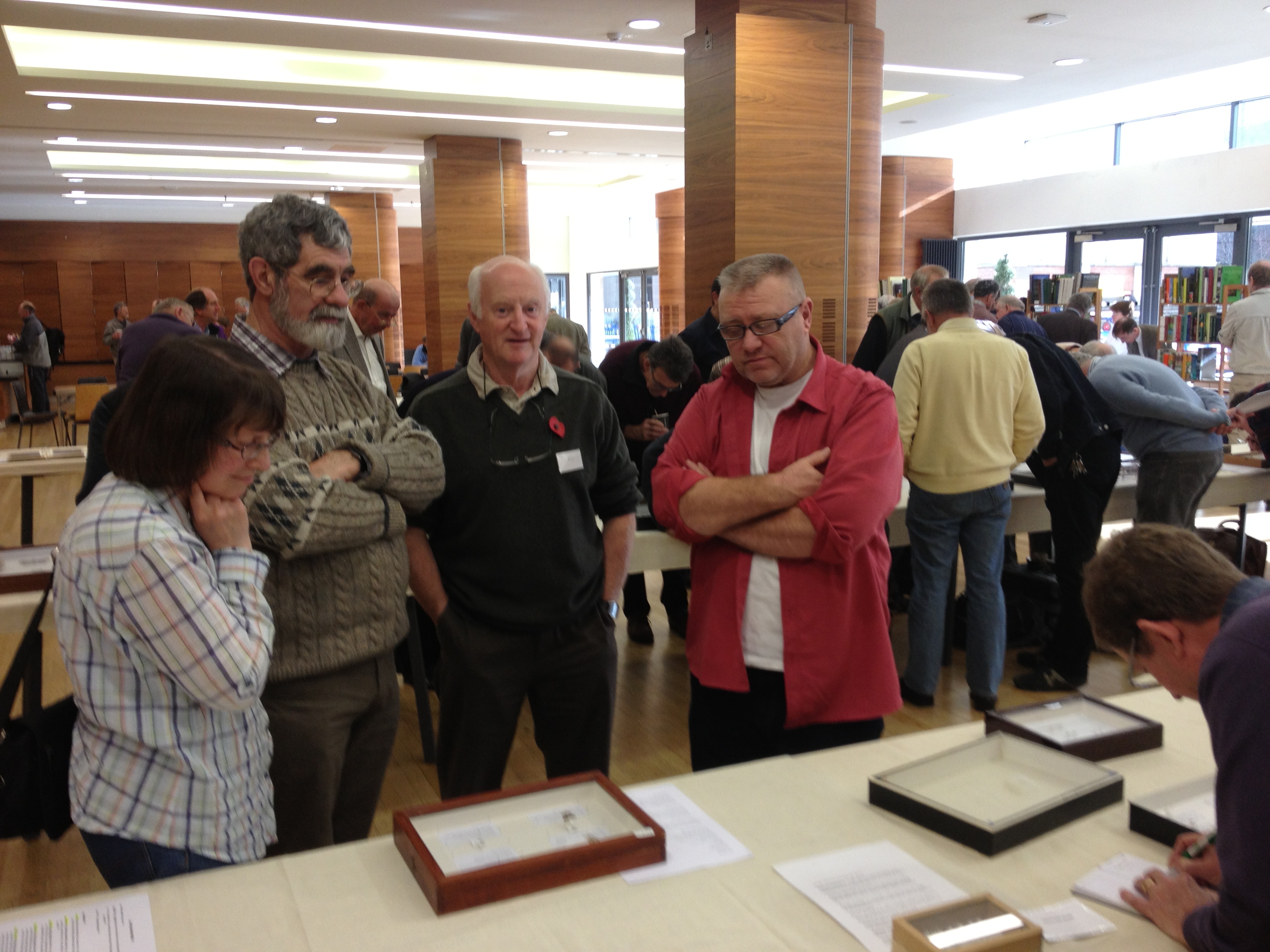
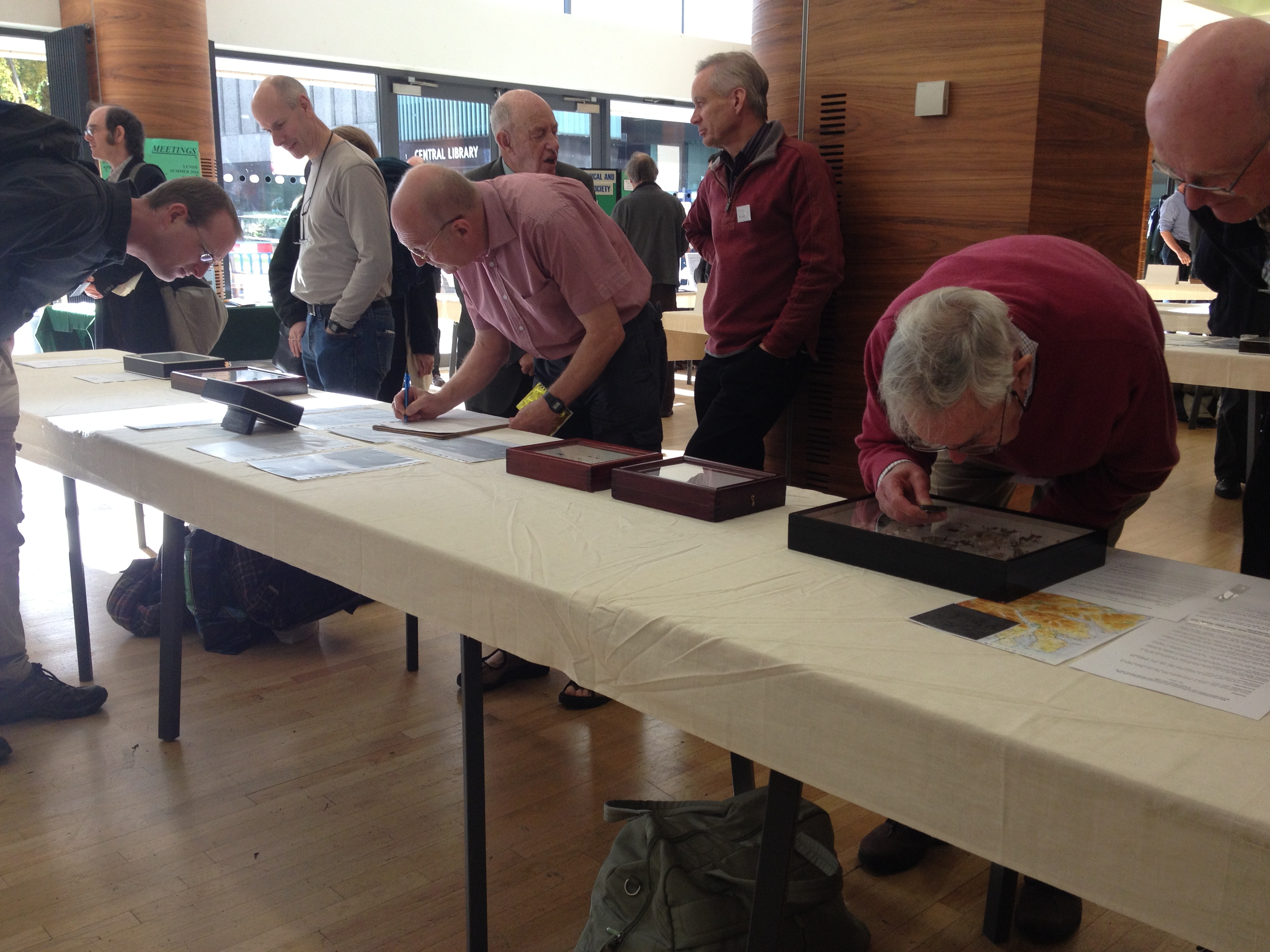
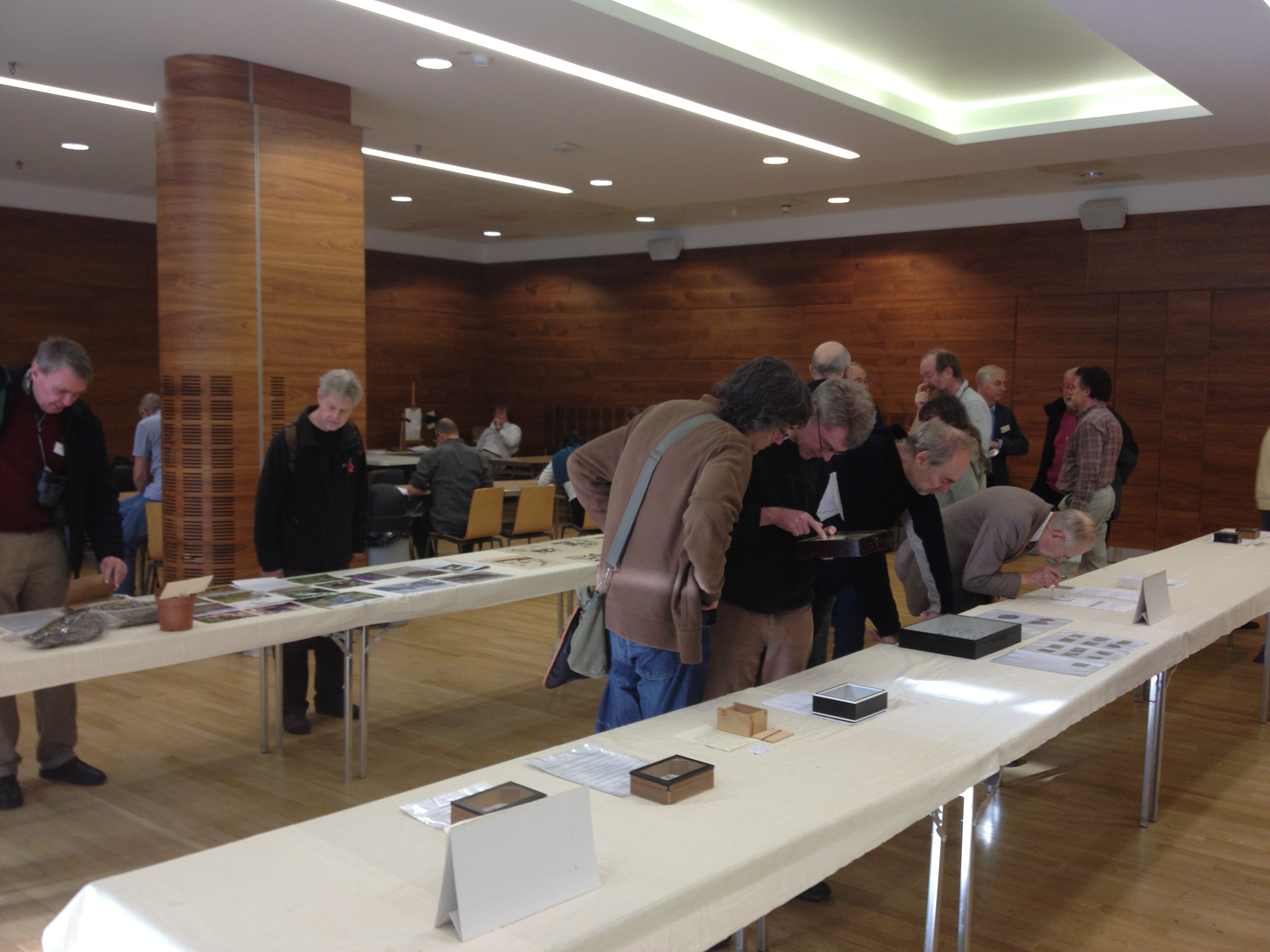
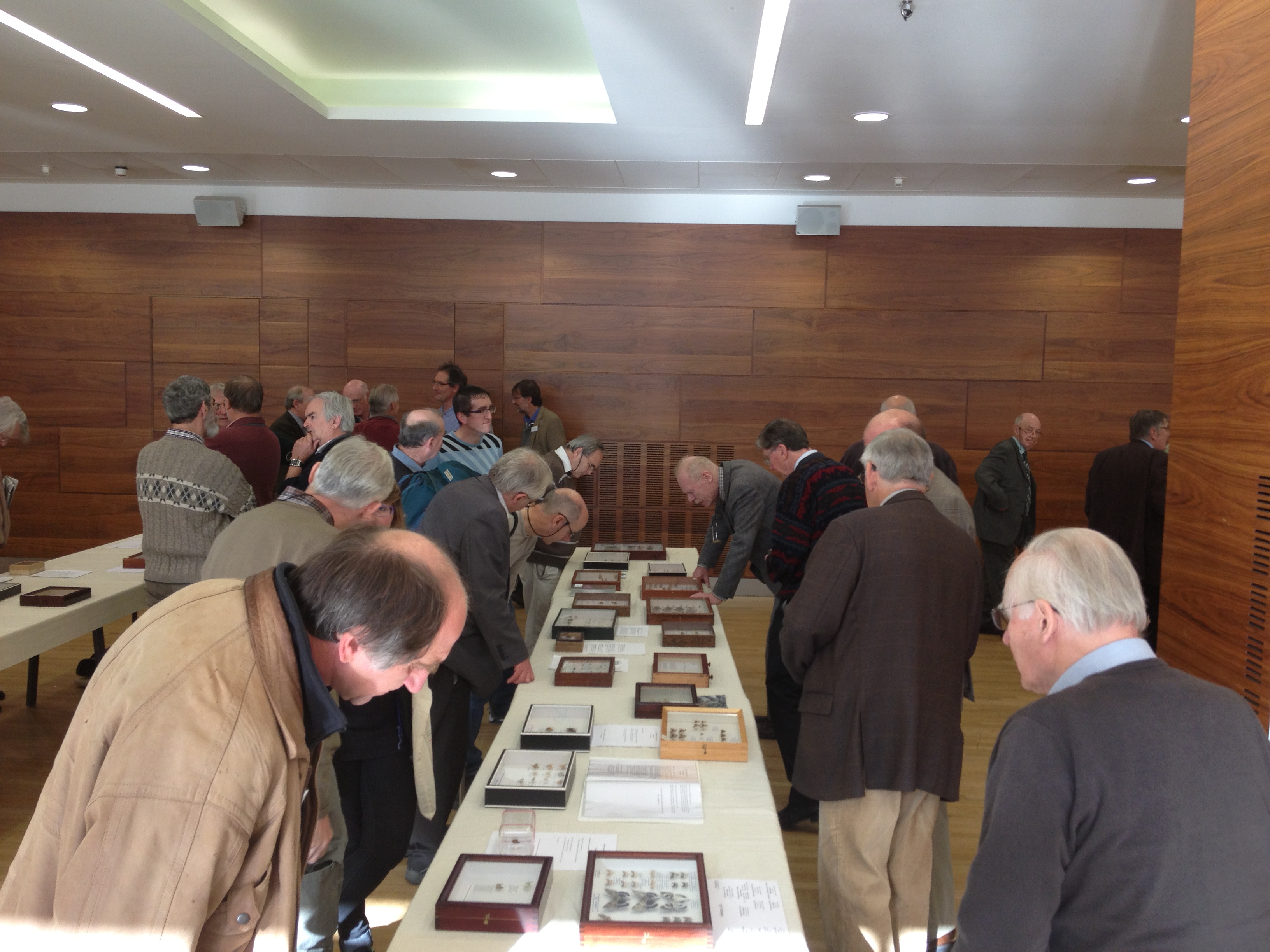
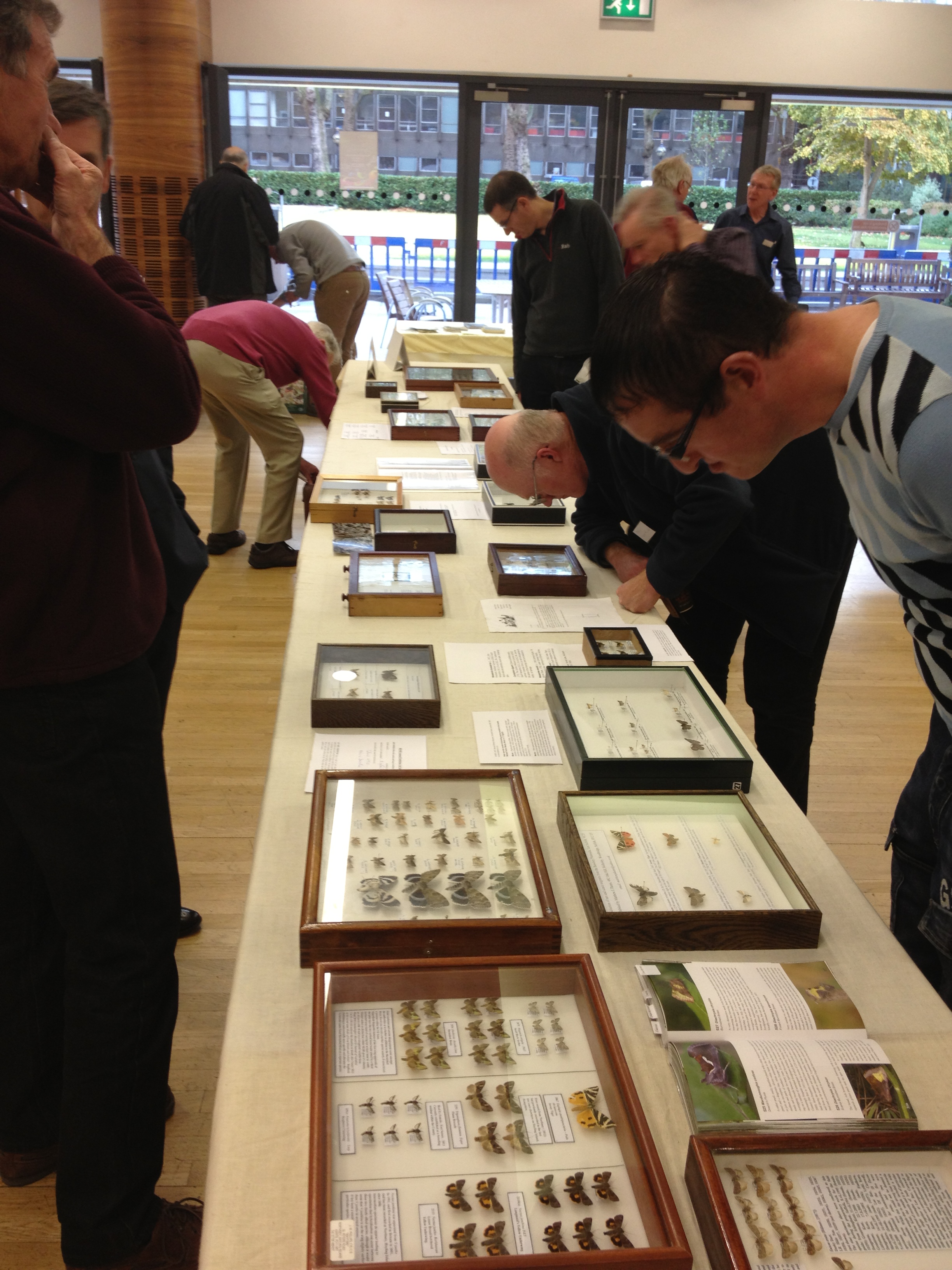
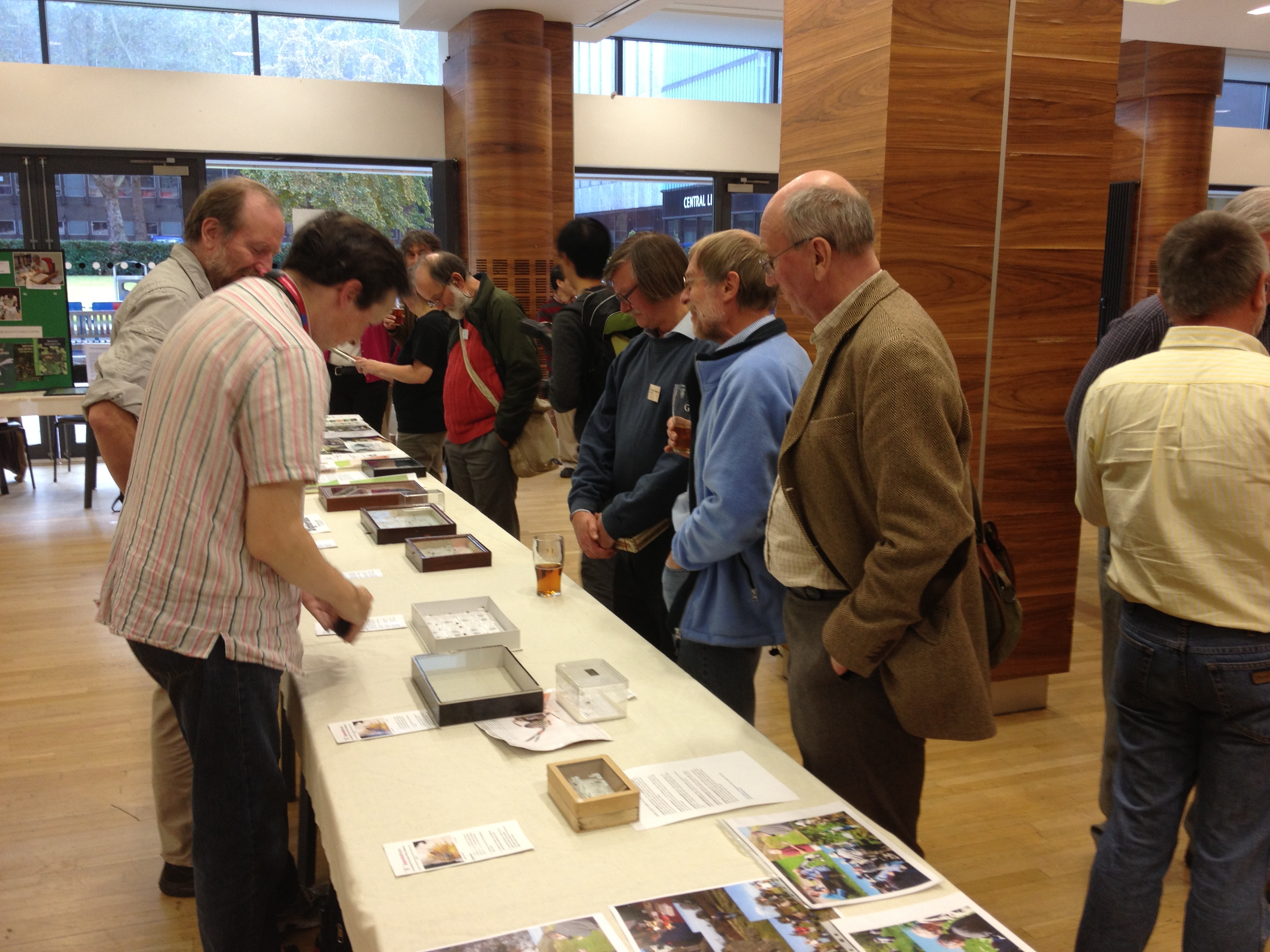
It’s a stoop. Other suggestions included a flutter, and a buzz. When entomologists come together at the annual exhibition of the British Entomological and Natural History Society, at Imperial College, they do two things: they talk incessantly in a strange dialect of copious Latin verbiage and abstruse jargon, and they stoop.

The stooping is done over  glass-topped display boxes showing the latest finds or discoveries. Here is the evidence.

This is one of my favourite meetings of the entomological year. It’s a chance to meet the faces behind the emails and the journal articles, to catch up and exchange the entomological news of the last 12 months, have a bit of a moan about the weather and pick up the latest books and journals.

OK, they do a fair bit of drinking beer too, but it’s the stooping that captures the mood of the day. So, there you have it — a stoop of entomologists.

Look what they found

The How to be a Curious Entomologist workshops were set up to teach people how to make an insect collection — simply, with easy, cheap, often home-made equipment. But why, in this day and age of electronic wizardly, high-spec digital cameras, email and internet should you need a collection? Because only about 5% of UK insect species can be definitively identified from a photo. Large moths, butterflies, dragonflies, grasshoppers and a few others are unmistakable. But that leaves 95% which can only be firmly named by looking at obscure characters under a microscope — often individual bristles on individual legs.

I recently undertook a reconnaissance survey visit to a small local nature reserve. It was late in the season, but I was told there were quite a few invertebrate records on file, collected over several years of casual observation. These would, no doubt, be useful. What I got was a list of common garden butterflies and bumblebees. The reserve warden was slightly disappointed when I all but dismissed them as useless. The trouble is they were all obvious common species that could be found in almost any garden in London. They gave no insight into the special habitat or distinct insect community of the site. If I had only been handed a scruffy box full of badly pinned and awkwardly carded insect specimens, oh how different it would have been.
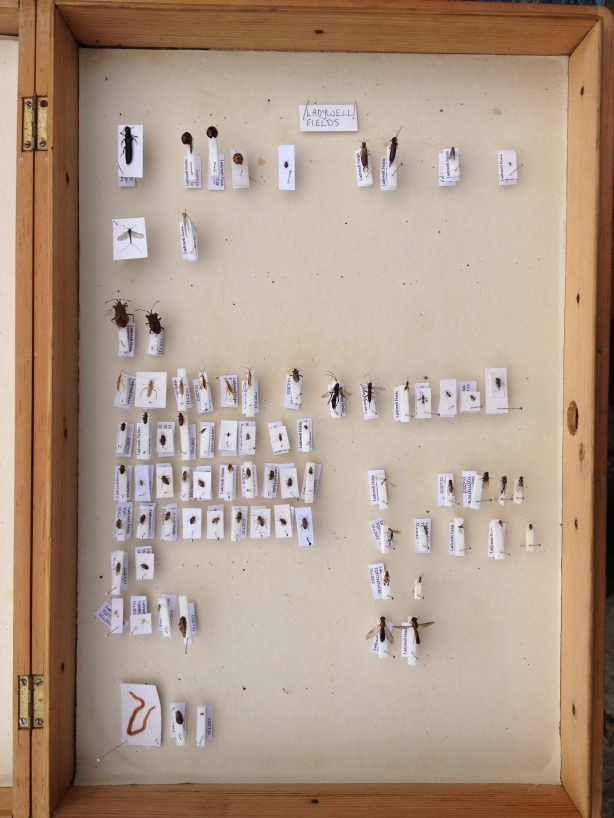
Late-in-the-season finds from Ladywell Fields.

After three curious workshops, we now have three prospective insect collections. They can be added to, piecemeal, over many years if need be. But whenever it comes to finding out what occurs on one of these sites, at least the incoming surveyor will have a starting point. And I know there are some gems in there.

The identifying bit of entomology is often what takes the time, and I just don’t have the time to work thoroughly through all of the collections we made, but here, at least, is a taster of some of the more unusual things that turned up.

Brachycarinus tigrinus Schiller, a small pale speckled ground bug (family Rhopalidae). This distinctive bug is a recent colonist to Britain, and was first found here in 2003, in Battersea Park, central London (by some chap called Jones, apparently). It has since been found in several brownfield localities in Essex and London, but is still very rare and confined to a narrow belt of localities in the Thames Gateway. It was almost the very first insect collected at the Deptford Creekside workshop, 30 June 2012.

Chaetostomella cylindrica, a very small pale picture-winged fly (family Tephritidae). Breeding in the heads of various thistles, and especially knapweed, this is a fairly widespread fly, occuring through most of Britain and Ireland, it is nevertheless not common, and I don’t come across it every day. Two specimens were collected during the Ladywell Fields workshop, 13.x.2012.

Cordylura albipes Fallén, a small black and white dung fly (family Scathophagidae). Much more secretive than the common yellow dungfly, Scathophaga stercoraria, and more rarely seen. No doubt feeding in the plentiful dog dung in Ladywell Fields, where it was found 13.x.2012.

Icterica westermanni (Meigen), a small orange picture-winged fly (family Tephritidae). This nationally scarce fly is known from an area south-east of a line from The Wash, to Gloucester to Weymouth. It breeds in the heads of ragwort, Senecio species. Despite its widespread and common foodplant it remains very elusive. This was one of the rare insect species highlighted by Buglife when it challenged proposed legislation to make ragwort a notifiable noxious weed. One was found by general sweeping at the Devonshire Road workshop, 29 July 2012.

Olibrus flavicornis (Sturm), a minute black flower beetle (family Phalacridae). According to the beetle review (1992), this beetle was considered to have red data book status ‘K’ — rare but insufficiently known. It can only be distinguished from others in the genus by microscopic examination of the microsculpture of the wing-cases. At the time it had not been seen since it was recorded in 1950 from Camber on the East Sussex coast. However, it is now known to occur, often in large numbers, on brownfield sites in London and the Thames Estuary. It is still very confined, geographically, and unknown away from this narrow region. It is usually found on autumn hawkbit Leontodon autumnalis, and possibly other similar plants. The larvae are thought to develop in the flower heads, while the adults feed on pollen. Several were found at the Deptford Creekside workshop, 30 June 2012.

Omalus aeneus (Fabricius), a very small metalic blue and green cuckoo wasp (family Chrysididae). One of the rubytails, so called because many are brilliantly red coloured, but not this one. Rubytails are cleptoparasitoids, or cuckoo wasps, laying their eggs in the nests of other wasp species; the hatching grub then devours the host egg and the food stores laid in for it. This one is known to parasitize various common species, but it is very local itself; it is more or less restricted to Kent, Surrey, Hampshire and Devon. One specimen was found during the Devonshire Road workshop, 29.vii.2012.

Pantilius tunicatus (Linnaeus), a large reddish brown and green capsid bug (family Miridae). Found on hazel, birch and alder, this handsome and distinctive bug is fairly widespread in southern England, but not common. Several were found in Sue Godfrey Nature Park, during the Deptford Crossfields Bioblitz, 15.ix.2012.

Rhyzobius chrysomeloides (Herbst), a minute black and pink ladybird (family Coccinellidae). This tiny beetle is extremely similar to a very common species, R. litura (Fabricius), and its occurrence in Britain was only recognized in 2000 when it was found in several Surrey localities. It is probable that this is a recent arrival in Britain and its spread has so far been monitored in Surrey, Kent, Middlesex, Berkshire, Hampshire and Sussex. One was beaten from some hawthorn hedging at the Ladywell Fields workshop, 13.x.2012.

Stictopleurus punctatonervosus (Goeze), a medium-sized brown leaf bug, family Rhopalidae. At the time of the national review of British Hemiptera, in 1992, this species was regarded as being extinct in Britain. It had been recorded from only two localities here, the last in 1870. It has now successfully recolonized Britain since it was recorded in Essex in 1997 and has now become a species typical of the dry, well-drained and sparsely vegetated brownfield sites in and around urban London, Thames Estuary and beyond. Specimens were found at the Deptford Crossfields bioblitz, 15.ix.2012 and at the Ladywell Fields workshop, 13.x.2012.

Not a bad start.

Oh, oh, unwelcome visitor in the collection

Luckily I have a separate museum beetle breeding facility. So when I uncovered this Dermestes larva chewing its way through some old specimens I have somewhere safe to keep it until it turns into an adult beetle.

I do occasionally get outbreaks of Anthrenus beetles, but I’ve never seen anything this large before.

Constant vigilance!