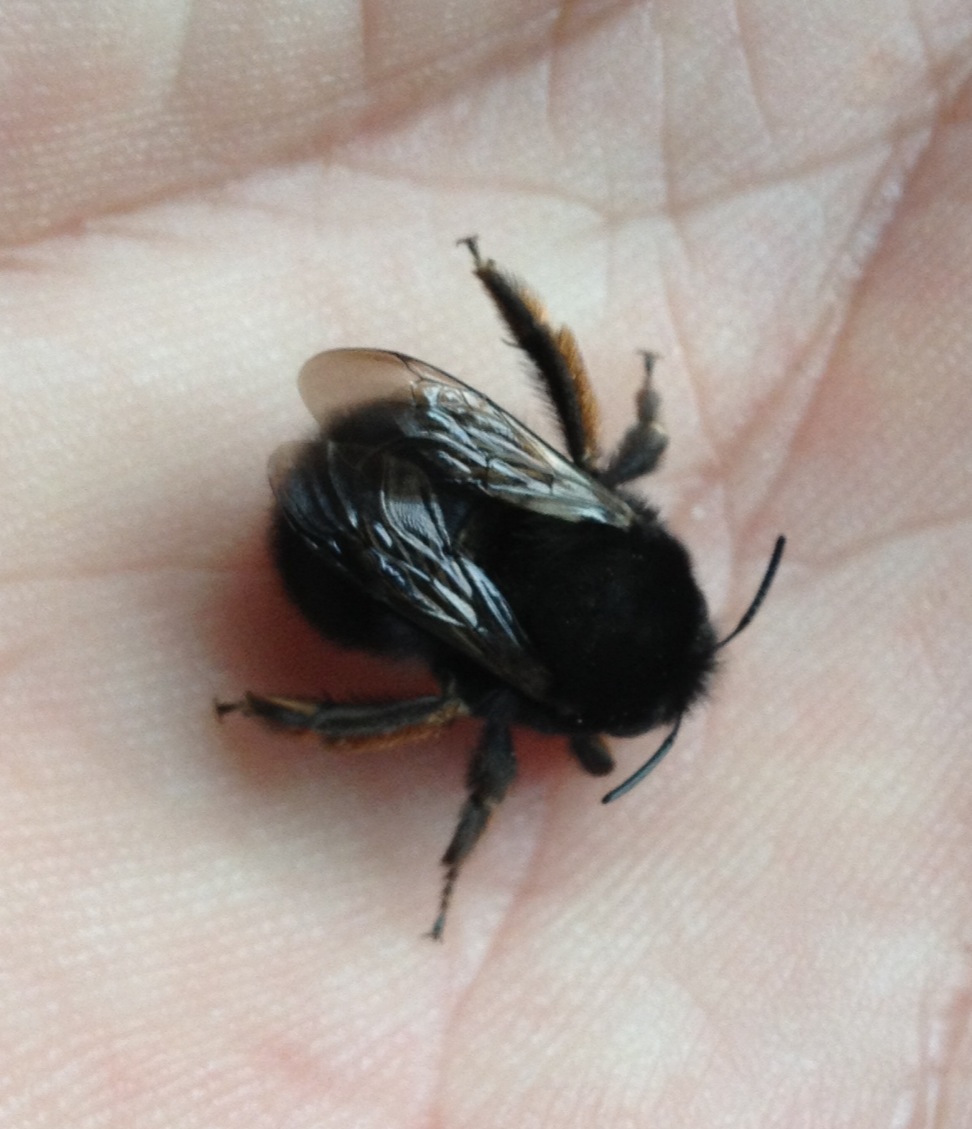
Despite the fur coat, she was having a hard time

Found this female Anthophora plumipes today, stalled on the pavement as a blistering wind whipped up the dusty remains of the frosty snow which fell on Saturday. Even with her thick hairy coat she was barely moving. Nothing is flying out there so I was a bit surprised to see her, presumably trying to forage. The thermometer has been below zero for several days now, and although the ground is no longer white, there is a pale remnant tucked down in the long grass.

The Verrall Supper 2013

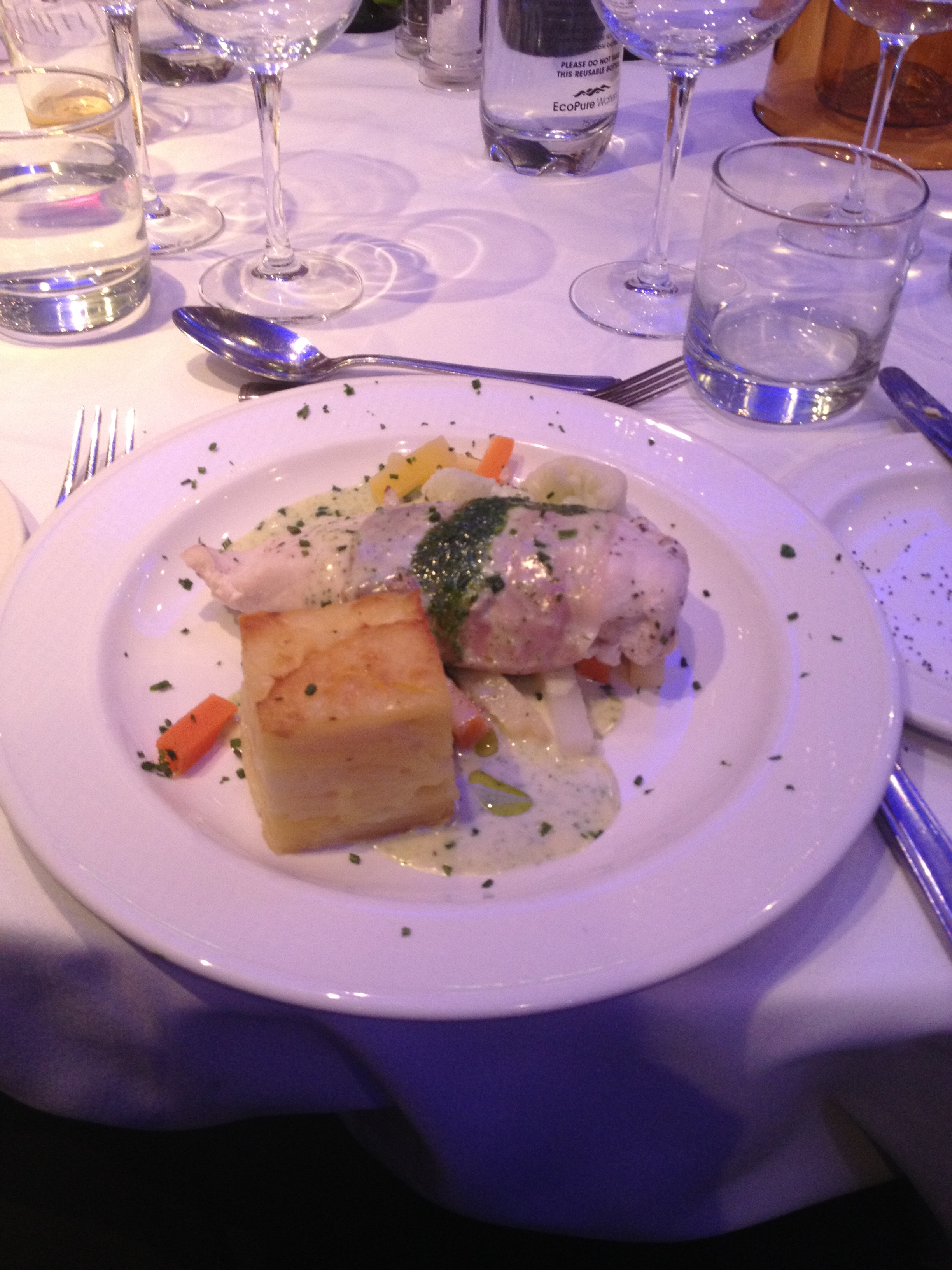
Yesterday was the Verrall Supper. Here it is:

Chicken, veg, and cuboid potatoes.

Chicken, veg, and cuboid potatoes.

And it was followed by the Verrall Pudding:

Very chocolaty indeed.

Very chocolaty indeed.

In a change from previous Verralls (2012 event here), it marked a move from Imperial College to the Rembrandt Hotel opposite the Victoria and Albert Museum.

All seemed well, despite the sinister novelty of round tables rather than long rows.

See you all again next year.

Rat dissection at Ivydale School Natural History Club gets a mixed reception

Well, I thought it was a grand idea. I’d just picked up some frozen fluffs for our rescue snake, and whilst I was in the pet shop I also picked up a large frozen white rat, £3.50 — a snip.

And what better than to snip it open at Ivydale School Natural History Club last week? Last year I rolled up with a beef heart to chop open, and after some initial squeamishness everyone wanted to pull it apart to have a look at the valves and the arterial connections.

Mr rat, though, got a rather different reception. OK, it did smell rather bloody, but even so I was slightly surprised at the seeming revulsion of a couple of the 9-year-olds. They were excused observational duties and skulked in a corner muttering, whilst the rest of us dug in.

It was definitely a Mr rat, by the way. The very large testes were spotted from the start.

At pick-up time the school office was abuzz with some of the kids telling their parents what they had just been up to. I’m still half expecting a complaining letter or two, though.

Just to finish, I love this quote, from eccentric Victorian naturalist Frank Buckland, Notes and jottings from animal life, 1882.

I owe a great deal to rats. When a student at St. George’s Hospital I wrote an article on rats, which I sent to a magazine, and to my great amazement the publishers sent me a cheque for it. From that moment I have taken a great liking to my first patrons in literature, viz. ‘Rats,’ and I always somehow connect them in my memory with publishers.

Specimen number 1

I’ve been rearranging my weevils. I like the weevils, despite some relatively tricky groups (for example Apion, Ceutorhynchus, Sitona, Phyllobius and Bagous), many have friendly patterns of brightly coloured scales and distinctive bold, domed, shapes. But my reference collection has become cramped to the point of near uselessness over the last 25 years.

Partly spurred on by the now complete set of weevil identification handbooks by Mike Morris, and partly by a glut of storeboxes, I’ve been spreading them out, allowing me to combine many boxes of ‘various’ specimens, and bringing them into one uniform, useful, series.

And I found this.

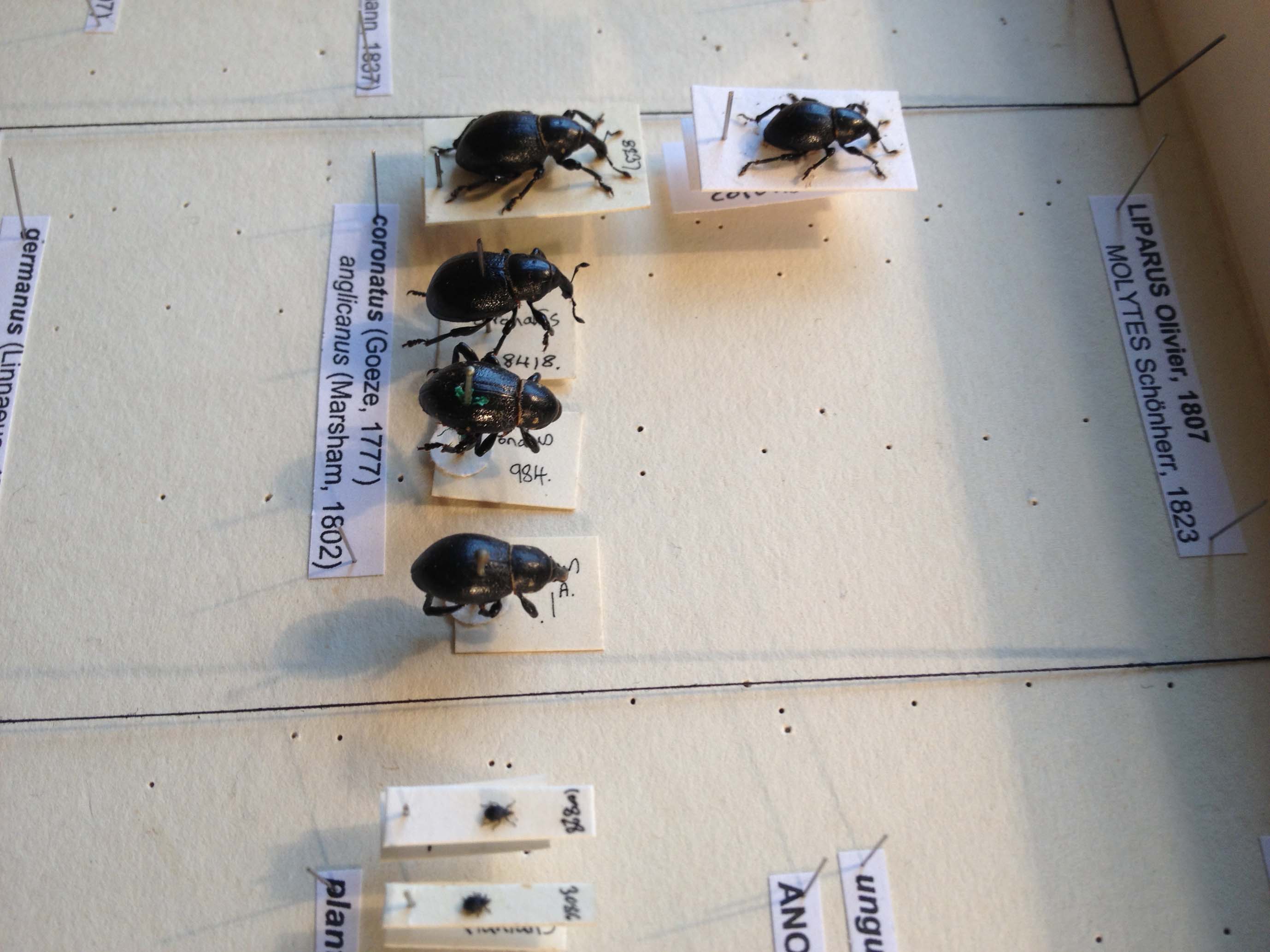
Specimen number 1. Liparus coronatus.

Specimen number 1. Liparus coronatus.

When I first started collecting insects, I numbered them in sequence, and wrote details in a catalogue. At some point in the early 1970s I acquired a proper insect cabinet. It cost me a tenner, and was a fairly rough, home-made affair, but it had drop in framed-glass lids — better than the four small cork-lined stationery (?) drawers I was using up until then.

At this point I threw out all the specimens being destroyed by museum beetles, Anthrenus. These were probably mostly butterflies, moths and hoverflies. I then renumbered the survivors. For some reason I numbered a queen buff-tailed bumblebee from 1968 as specimen 1, but my catalogue clearly shows the first entry was specimen 1A, Liparus coronatus, found in Friston Forest, on 11 June 1967.

With hindsight I think this was a good place to start.

Why do I have a collection of ladybirds?

The thing which, in most people’s eyes, defines me as an entomologist is not my comical antics with a sweep net, my morbid curiosity of animal droppings and carrion, or my excessive enthusiasm for tiny biting specks of obviously malignant animated matter living in their children’s hair — it is the fact that I have an insect collection. In an era of ultra-sleek cameras, optically pure macro-lenses, high-resolution digital images and the wonderfully interactive labyrinth of the internet, a series of stiff dry insect bodies pinned into a small wooden box seems not a little archaic.

If people see the contents of a glass-topped drawer or an open store-box, laid out beside a microscope on my kitchen table, responses to it are varied. At the one end of the curiosity scale (usually voiced by children), there is: “Wow, did you kill all these yourself?” At the other end (usually from their parents, squinting at the tiny specks of nothingness which are chalcidid wasps or seed weevils) is: “Wow, how on Earth do you find these things?” This is a polite interest, but I often get the feeling there is also a hidden suspicion: “He kills the things he claims to love?!”.

There are, of course, the well-rehearsed arguments — the sheer unimaginable numbers of insects hidden all around us, their prodigious fecundity, and the mathematical impossibility of entomologists doing any harm by collecting a few specimens, even a lot of specimens maybe. When I spoke to some novice potential entomologists last year I tried to dumbfound them with a rough calculation I did on the back of a proverbial envelope*: more insects were killed in the building of the 2012 London Olympics, than have been collected and killed by all the entomologists in the world, who have ever lived, ever.

It’s a statistic to get people thinking, at least, but there is still some unease at the idea of a ‘collection’. For what is a collection if not a vainglorious display of prize trophies? It’s here I have to start making the other familiar claims about not being able to identify tiny insects unless a specimen can be minutely examined — often individual bristles on individual legs. My stock statistic is that I reckon on something like 1500 British insects being easily identified from a photograph; but since there are over 25, 000 species here, it means that nearly 95% of UK insects need confirmation under the microscope. This doesn’t even take into account the fact that plenty have various colour forms, males and females differ, and all have very different larvae and nymphs too. Sometimes the distinctions are so fine that a large series of specimens from various localities, found over many years, often have to be compared to identify them firmly.

The trouble is that the physical presence of the ‘collection’, with its neatly aligned rows of carefully mounted insects and painstakingly presented labels and headings, is still very much a hang-over from the past — a past where collecting something for the sake of it, to own it, to savour it, and to display it proudly and overtly, was a perfectly acceptable scientific procedure.

For nearly half a century, though, there has been a formal published code for collecting. It appeared at a time when butterfly collecting began to be viewed with mistrust, (and egg-collecting became the criminal activity of a rogue underclass). Just over 10 years ago I was pleased to be involved with reviewing it, and if I may make so bold, my greatest contribution was to get its title changed to a ‘Code for Collecting Insects’ where previously it had been a code for ‘insect collecting’.

Here is a subtle, but fundamental difference. One, like stamp collecting, or egg collecting, is all about making that private, often secretive, vanity-stoking display to show off magnificent captures. The other emphasizes the workaday need to maintain an ordered and accessible scientific reference collection to aid and support identification, and to advance entomology further. This is why a collection is necessary.

So why do I have a collection of ladybirds? Intuitively, they fall into the group of 1500 UK species which can more or less reliably be identified from a photograph, and surely they can all be firmly named under a hand lens in the field. Except, as any entomologist will agree, things are never quite this easy.

Firstly, there are the ‘other’ ladybirds. These are the remaining 25 small (2.5 mm) to tiny (1 mm) non-brightly-spotted beetles in the family, which include the sometimes notorious genera Scymnus and Nephus, which can fox even the most experienced eye. There are the ridiculous number of confusingly different colour forms and fluctuating spot patterns of several very common species. Occasionally I’ve found something that just looked ‘a bit odd’ in the field; maybe I hoped they would prove to be something new. And I’ve also accumulated dead specimens from traps, which would otherwise simply be discarded.

All these are good enough reasons, but the honest truth is that I have a ladybird collection because sometimes I need a prominent display of obvious and familiar insects that I can show off.
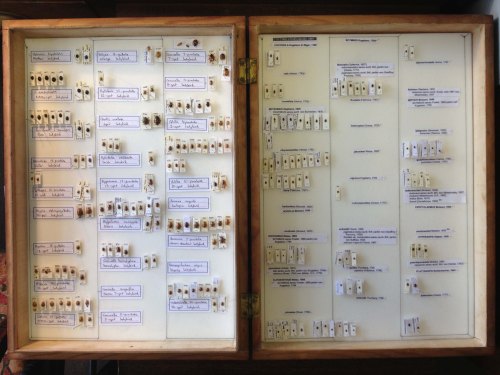
Ladybirds to the left, 'others' to the right.

Ladybirds to the left, ‘others’ to the right.

Although they would do just as well, I don’t have any butterflies, or moths, or dragonflies. A bunch of 8-year-olds might be enthusiastically scandalized by a display of sombre dung beetles, or fascinated by a box of pretty glittering rubytail wasps, but they can’t relate to them in the way that they can to the spotty, domed, brightly coloured beetles they all know so well. Looking at ladybirds, with their strong colour schemes and easy spot-number names, children can get an immediate understanding of such basic concepts as: species, genus, variation and rarity. The display collection (as opposed to the reference collection) still does have a place.

And I admit, I do still collect the occasional ladybird. Is this a bad thing?

……………………………………………………………………………………………………………..

* My calculations went something like this. The Olympic park in East London is 2.5 km2, that’s 2.5 x 10⁶ m2, so with a nominal insect density of 1000/m2 we would get 2.5 x 10⁹ (two and a half billion) insects destroyed. This is roughly forty times the size of the Natural History Museum’s insect holdings (60 million specimens). The museum has the largest collection (by a long way) anywhere in the world, so 40 of them ought to be enough to equate to world-wide entomological activity during, say, the last 200 years. I hope I’ve built enough latitude into the equation: actually insects are often quoted at densities over 10,000/m2, and I did not take into account any of the other Olympic venues around the country.

BENHS Coleoptera Meeting 2013

Today was the British Entomological and Natural History Society‘s 10th annual Coleoptera Meeting, this time held at the Hope Department of Entomology, in Oxford University’s Natural History Museum.

Just before the start, in the lecture theatre.

Just before the start, in the lecture theatre.

The Museum itself was closed, displays are boarded over and exhibits are bubble-wrapped against damage as the leaking glass roof is repaired.

Darren Mann gave some of us a guided show-and-tell tour of the department, including a history of the collections, a selection of Darwin/ Wallace/ Fabrician and other types, and made some choice comments about the poor funding given to the natural history collections of provincial museums.

Thereafter people divided into various laboratory spaces to look through the collections, library or take part in a dung-beetle identification workshop. Much chat and good-natured banter ensued.

This was the first BENHS beetle meeting I’ve been to, others held in the society’s headquarters at Dinton Pastures have always seemed too much of a logistically difficult journey from south-east London. I might have to rethink this.

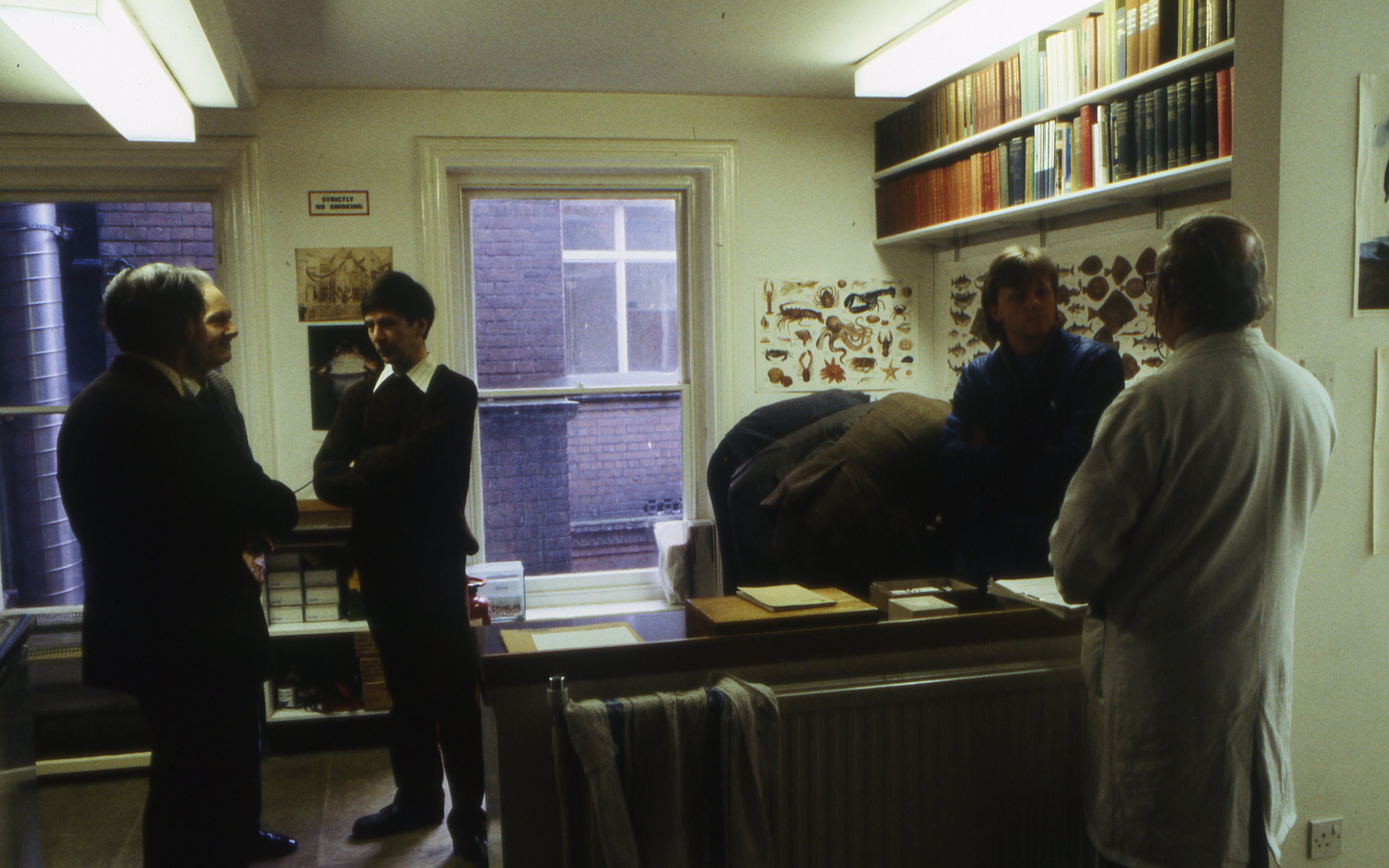
The day also put me in mind of another, similar event, held some time earlier. On 16 March 1985, Eric Philp organized a Coleoptera workshop at Maidstone Museum. Here we are:

Left to right: My father Alfred W. Jones (back towards the camera), A.A. Allen (just peeking out), Peter Hodge (arms crossed), Mark Colville and Eric Philp. Not sure who are the three bods stooping over a display at the back of the room.

Left to right: My father Alfred W. Jones (back towards the camera), A.A. Allen (just peeking out), Peter Hodge (arms crossed), Mark Colvin and Eric Philp. Not sure who are the three bods stooping over a display at the back of the room. Three names that come to mind are John Parry, David Porter and John Owen, but these are all guesses.

Eric died on 8 January and I went along to his funeral last Tuesday, 29 January.  I always knew Eric as a coleopterist, but most others knew him also as an ornithologist, or a botanist. As usual talk centred around reminiscing and someone else commented that Eric always wore his lab coat when working in the museum. It was almost his badge of office. I wonder if Darren has a white coat?

The insects of the septic fringe — another reason to ignore brownfields?

I recently came across the term “septic fringe”, so of course I couldn’t resist using it. It was originally used in a sociological context to describe the squalid shanty-towns and peri-urban sprawl in developing centres. It immediately struck a chord with me; I fancied that I recognized it … or at least the shadow that remains decades (or centuries) on from slum clearance and piecemeal gentrification.

The brownfield jungle, once septic fringe?

The brownfield jungle, once part of the septic fringe?

The septic fringe is the unregulated, unplanned, insanitary and sometimes lawless squatter zone around the edge of a city. Fuelled by rural-to-urban migration it is built higgledy-piggledy, often along main roads, using whatever scavenged materials may be to hand, without any sewage or waste disposal system and without access to clean water.
Its unfortunate entomological significance lies in the plentiful opportunities that it affords pest insects, particularly disease vectors like mosquitoes, blackflies, blowflies, fleas and cockroaches, breeding in the disordered filth, and with access to a typically overcrowded, poverty-stricken and disease-ridden populace.

There is also an implicit assumption that, further back in human prehistory, a similar, though smaller, septic fringe around the most basic settlements of early protohumans allowed some insects access to a new ecological niche — our domestic dwellings. The reasoning goes that latrines, along with rubbish and food remains dumped around the edge of the basic human encampment, encouraged insect scavengers from the surrounding wilderness, and that these later moved in to attack food stores, skins, fabrics and structural timber as the previously sparse nomadic hunter-gatherer population became more settled and adopted to live in houses — or at least started to inhabit semi-permanent shelters, rather than temporary bivouacs.

The septic fringe is still a feature of many major Third World cities like Rio de Janeiro, Jakarta and Soweto. It happened rather longer ago in London, nevertheless….

To counter the septic fringe is an alternative concept — the affluent fringe. This time following a reverse migration from cities after World War II, colonization was into the suburbs. It left behind partly bombed inner city areas which were poorly populated, and perhaps populated by the poor. Slum clearance created the 1960s housing estates which are also presently being demolished, and a still-ongoing cyclical gentrification uplifts one set of streets, while another area suffers decline. This septic fringe is now a decayed ring between the central city core and the suburbs, and it is where some of the best (and most vulnerable) brownfield sites lie.

Deep in the city centre (London at least) buildings are still being demolished and new developments go ahead, but there is practically no gap between clearance and build; brownfield sites are very short-lived, if lived at all. There is barely a moment between the last load of rubble being carted away and the first load of concrete being laid. Further out, though, sites are still cleared before the next stage of their existence is finalized. It is here that the brownfield sites become unofficial wildlife reserves.

It is also here that derelict and apparently abandoned sites seem to be festering, where land-prices are at their most volatile, and where the wildlife value of these scrappy-looking bits of land is under-appreciated (it’s not real countryside, after all).

Just as the infected-sounding nature of the septic fringe is unappealing and uninviting, the often ugly-looking and dangerous-seeming ‘waste’ land of brownfield sites is also easily disparaged.

I came across the notion of the septic fringe whilst researching a book about household insect pests, where they originally came from ‘in the wild’, and how and when they adapted to become household invaders. The analogy between the septic fringe and the brownfield ring is, perhaps, slightly fanciful, but I’d argue that the hazy, dirty, irregular junction where human activity meets nature is still an important zone to study.

It’s lice Jim, but not as we know it

Tiny specks of creeping animated matter have been living in my kitchen for years. I’ve known vaguely what they were — psochids — but have never really paid them much attention. However, work continues on House Guests, House Pests, and as I weave my way through compiling the ID guide appendix, I feel it incumbent upon myself to have a closer look. I found this one in the bottom drawer of the pull-out larder, grazing on a drift of spilled self-raising flour.

Lepinotus patruelis, bottom drawer of pull-out larder, in spilled flour, 8.i.2013.

A Lepinotus species, but is it a book-louse or a bark-louse?

It’s probably one of the three Lepinotus species recorded as British. It was the National Barkfly Recording Scheme website that first alerted me to its identity. I’ve not had much luck trying to get beyond the genus, the Royal Entomological Society handbook relies on characters on the tiny wing scales, but my specimen is either not quite mature, or has lost them.

Being a synanthropic (domestic) insect, the word ‘barkfly’ seems a bit odd, especially as this species is wingless, and obviously can’t fly. It’s strange how even some biological recording schemes eschew scientific names — ‘The National Psochoptera Recording Scheme’ would have worked for me.

I tried referring to them as ‘book-lice’, but they don’t really live on books either. Even the psochid species recorded in ‘old libraries’ probably don’t eat the books, they most likely gnaw the fungal hyphae of moulds attacking the flour-based pastes and sizes used in traditional bookbinding.

Louse is a fine old word for any small mean creeping thing, and although it has been rather purloined by those ranting on about head lice, there are plenty of other examples including: woodlouse (the familiar domed garden crustaceans), hoglice (freshwater woodlice), fish-lice (flat prawn-like fish parasites), plant-lice (aphids and scale insects), bark-lice (as previously mentioned) run up and down on tree trunks nibbling lichens and mildew and book-lice (on festering tomes in decrepit libraries).

I’m going to coin the name flour-lice. Any objections?

So what’s a codling moth doing flying about in the kitchen on Christmas Eve?

At first I didn’t recognize it because it was so dark, and the usual grey wrinkled bars were barely perceptible. But under a microscope it has the distinctive brown ocellus, vaguely purpled, strongly edged by golden coppery arcs, and the dark tornus streak wrapped about its inner margin.

All the books say Cydia pomonella is double-brooded, flying end of May to October, so 24 December seems a tad late.

Admittedly my kitchen is not very seasonal, but I’m still left wondering what’s going on. I have only one suggestion.

Although we’ve been buying apples all month, the books also claim that codling moth is no longer a shop species, because of all the pesticides; instead it has become a garden moth, living in the random garden apple trees planted across the nation. We have one, and our apples are riddled with the insect every year.

All our home-grown apples are used up now, but what if a caterpillar crawled out of the infested fruit when I was storing it in the biscuit-and-cat-food section of the cupboard under the sink? The moth’s larva usually over-winters in the leaf litter, having gnawed its way out of the windfall in September. Perhaps it had been waiting for spring, tucked up behind a twist of plumbing. But it somehow got confused by the cooking heat and pupated early.

Does this seem reasonable?

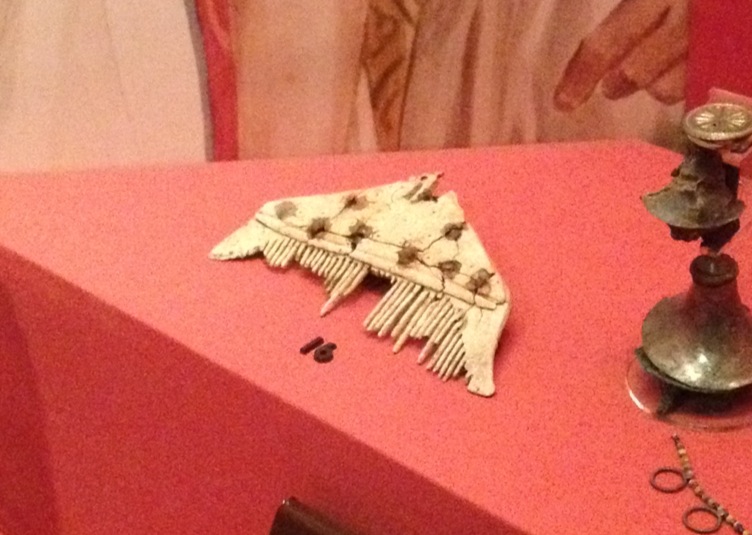
Another museum, another comb

The Museum of London, today, with 120 seven-year-olds to study Roman Britain.

There was a comb. Just the one. But it didn’t look as if it would get out many head-lice. Even in pristine, non-broken condition the teeth were too widely spaced.

They were useless, them Romans. Really lousy.