The four-spot ladybird

It’s always interesting to find a new ladybird in the garden, and today’s is Nephus quadrimaculatus. At just over a millimetre and a half long it’s not really a ladybird in the popular sense, but it’s a perfectly valid member of the ladybird family Coccinellidae.

Once regarded as one of our rarest beetles, it was formerly called Nephus pulchellus (beautiful) because of its pretty markings. When Canon W. W. Fowler wrote his beetle monograph in 1889 he knew of only one genuine specimen, from Kent.

Things have changed a bit since. There have been a recent spate of records from Surrey and Kent, and a few other localities in southern England. It seems to like ivy, and maybe feeds on scale insects and mealybugs.

But it’s still decidedly uncommon. OK, it’s not a brilliant photo, taken down the barrel of a microscope, on my phone, but it’s still a nice thing to drop out of the ivy on my garden fence.

Wildlife Photographer of the Year 2012

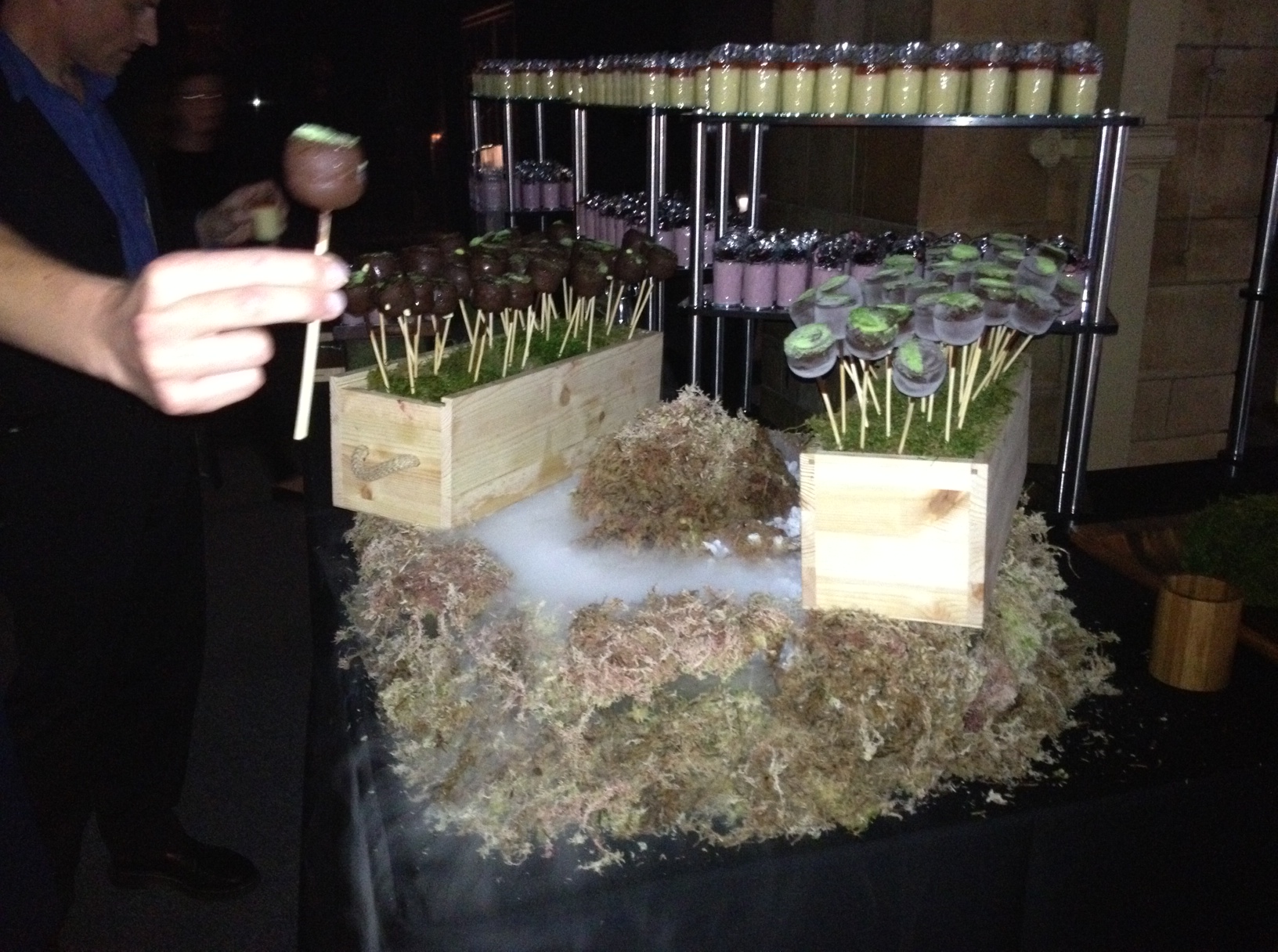
For several years running, as BBC Wildlife‘s Bug Czar, I’ve managed to wangle an invite to the Wildlife Photographer of the Year award ceremony held up at the Natural History Museum. It’s a great bash — fantastic, subtly lit setting around the Diplodocus skeleton in the museum’s main atrium, interesting chat with photographers and the bods from the magazine and the environmental industry. Good food and stunning pictures.

I always have a slight moan about not many insect pictures. Although I had to shut up two years ago when a photo of leaf-cutter ants won the final overall prize. This year was even more pathetic — only two insect photographs, both flies, and one the stereotype of bad insect behaviour, a mosquito sucking blood from a bare arm.

Bill Oddie (he said, name-dropping), who was sitting one person away from me at table 18 was almost equally disparaging about all the pretty pictures of penguins and cheetahs and flamingoes. His gripe, and I follow him here, is that when people see pretty pictures of animals they feel good. But what they really need to see, even if they don’t want to, is pictures of the terrible destruction, desecration, corruption and dilution of nature. Then they’ll do something about it.

It’s a difficult one. The competition is now so big, and for all its partners (BBC Wildlife, Natural History Museum and Veolia Environnement) it has become a prestigious showcase of wonderful pictures that are flashed all around the world. These are aspirational brands, rather than campaigning organizations, and they need feel-good images. A selection of pictures is available through the websites of The Guardian, MSN, or The Metro; they show some of the typical portraits.

There were some challenging images, the photojournalism themes showed harrowing pictures of rhino poaching and tiger rainforest destruction, there were bleak pictures of African wild dogs and melting ice floes. But during the presentation itself I felt slightly underwhelmed. This was partly because I find pretty pictures not so very interesting. It was also partly because of the format of the evening. We only got to see runner up and winner of each category — a small proportion of the pictures on show in the display gallery. But we had to wait until after the dinner and awards announcements before we were let into the exhibition hall to see the rest.

It was not always so; until 2010 the initial gathering always took place amidst the displayed pictures, and there was much commentary and debate about which photos might be winners, and why. Here was a chance to see all the cuddly mammals and awe-inspiring landscape pictures, and the disturbing ones too. There has always been a smattering of insect photos, which, by the very nature of getting close to a bug, are challenging or disturbing — much more likely to elicit the response “so what’s going on here, then”, rather than “wow, pretty”. To select 2 insects from over 48,000 entries seems a bit lame. Either the judges need to get their thinking right; or entomologists need to submit more pictures.

How to be a curious entomologist — 3


Saturday 13 October 2012 saw 15 people huddled into the cosy (= small) Ladywell Fields Environmental Centre for the third Curious Entomologist Workshop run by the London Borough of Lewisham’s Rivers and People Project.

For follow-up information on techniques and equipment, and links to suppliers, organizations, societies and recording schemes, go to the report of the first workshop and scroll down the page.

***********************************************************************

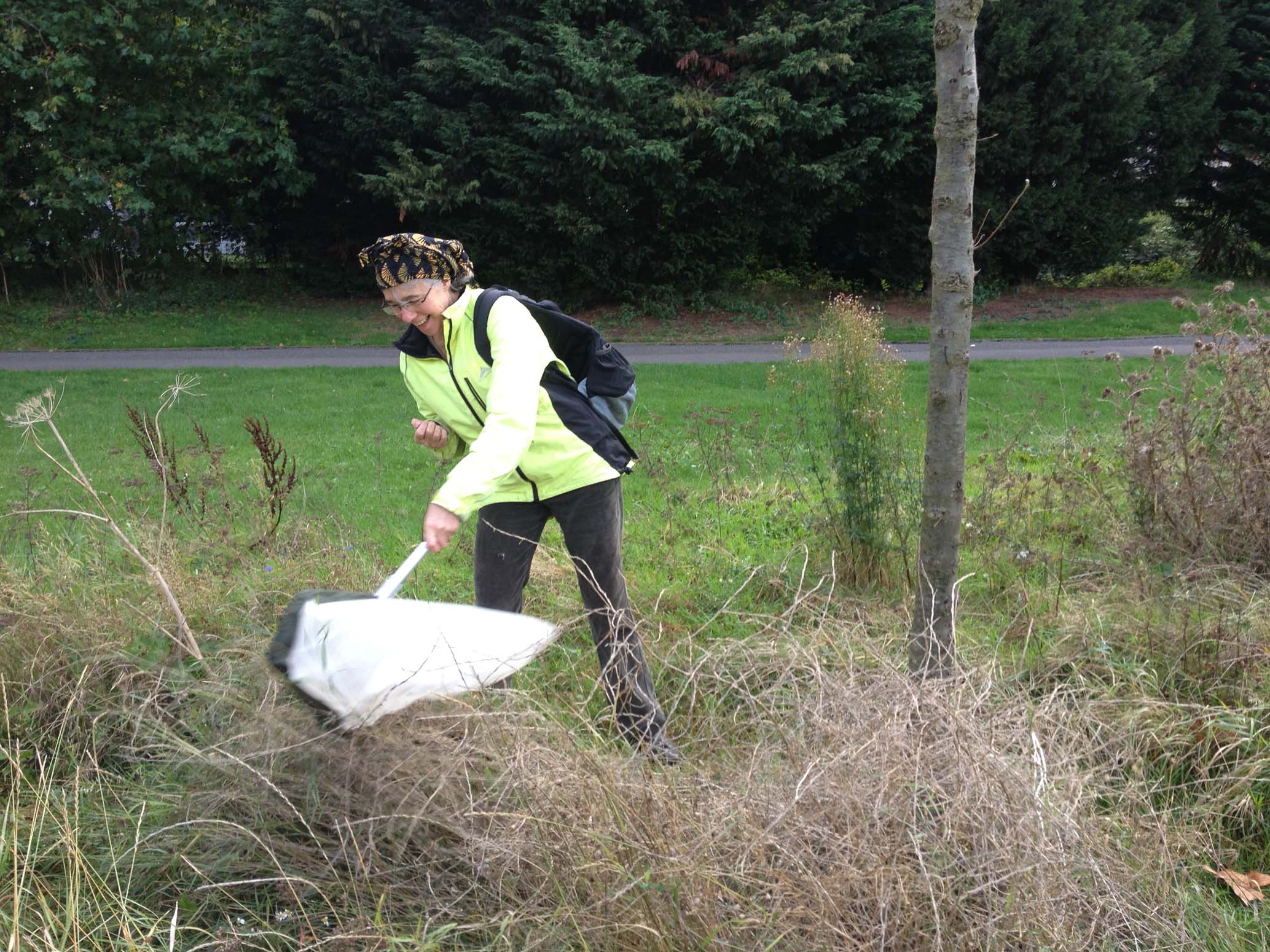
As usual, the first thing was to find some specimens, and despite the lateness in the season we had no trouble.

You can’t beat a sweep net.

A river runs through it, even.

A lime tree provided several colour morphs of the harlequin ladybird.

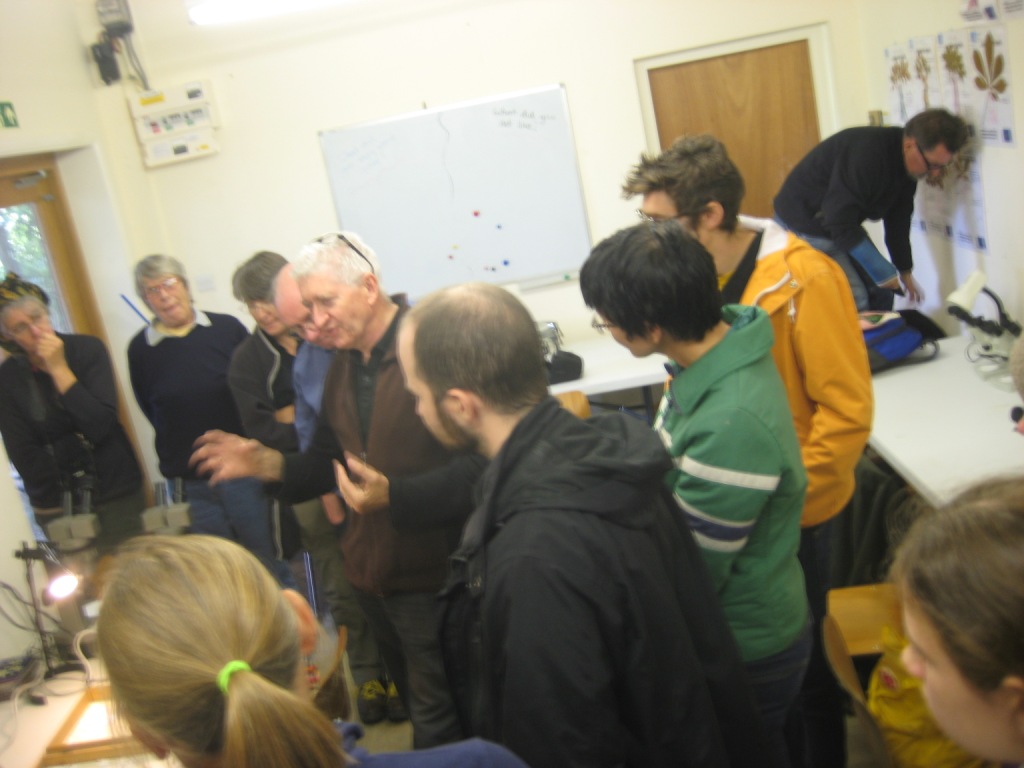
I, again, found it really satisfying talking and enthusing about entomology, and the importance of keeping some specimens to make a collection. And I think everyone who attended came away with some satisfaction that we had amassed a reasonable number of specimens at the day’s end.


Several people felt inclined to take photos of the final collection.

The specimens, along with those from Deptford Creekside and Devonshire Road Nature Reserve, will now be kept in the hope that they will be added to, and eventually become part of any baseline environmental surveys of the sites.

What to do with the left-overs?

Survey left-overs — there’s no room in the reference collection for everything.

I’ve just delivered a store-box full of left-overs to the Horniman Museum. They can use them in their hands-on spaces, without fear of losing their own valuable or important specimens. They are the remnants of various surveys; they’ve served their purpose, but now they are surplus to requirements.

***********************************************************************

Every time I visit a site to record insects, I have to make an identification-potential decision for each insect I find. Since the ‘species’ is the currency of most ecological surveys, I have to make a judgement about how realistically I can correctly identify each individual to species level. I can hardly turn in a report claiming to have found “lots of pretty spiders, some hairy flies and a disgusting worm”. Although, that might make for some interesting reading and controversial management suggestions.

There are several different categories along my ease-of-identification spectrum:

  • 1) Large, obvious, distinctive species that I can readily recognize in the field with just a glance.
  • 2) Smaller, more tricky things that I need to examine closely, maybe under a hand lens, but which can then be released.
  • 3) Specimens that need to be collected. They have to be examined under a microscope, and good lighting. They may have to be compared to other specimens in a reference collection.
  • 4) Small fry that I’ve got an idea what family or genus they’re in, but which are known to be awkward, and which I’ll probably have to send off to some specialist, or sit on for years until I have enough to start making a reasonable reference collection.
  • 5) Rejects. No hopers. There’s no point in taking a specimen; it will never get identified.

Despite the thrill of finding a great silver diving beetle, or a purple hairstreak, distinctive and charismatic creatures that can easily be identified in the field, most of the category 1 and 2 insects are common and widespread, fascinating perhaps, but ultimately not very informative about any given habitat because of their ubiquity.

Likewise, at the other end of the scale, the huge numbers of teeny-tiny crawling and squirming things barely visible, all the immatures and nymphs and spiderlings, all the ‘problem’ groups (don’t mention ichneumons) are not worth the effort, I’m on a limited budget and  have limited time. In the interests of propitiousness and convenience, these have to be rejected at the first.

Not surprisingly it is the intermediates which are most useful. These are the unfamiliar, sometimes more awkward, but nevertheless workable insects (mostly small beetles, flies, bugs, bees, wasps and ants), and they can tell us more about a site than any number of bright but common butterflies. But it is these that need the most careful study and identification. They’re the ones that need to be examined under a microscope.

At the end of the season, when I finally get round to identifying things, I can work my way through most of category 3 and some of category 4. Here come the surprises — the rarities and oddities which would have been overlooked but for the presence of a specimen under the microscope.

Now, after years of moderately serious entomology, my reference collection is starting to fill up, and I just don’t have the room to incorporate much more. I still have to collect a specimen to correctly identify it, but I feel guilty about the time and effort spent catching, killing, mounting and examining it. I’m loath to throw it away. So, for now, the Horniman Museum gets them and they pass from scientific study to educational. Natural recycling, I call it.

Peekaboo

I’m not sure whether it’s hiding, or maybe it’s eating the remains of the snail, but this distinctive little beetle did not notice me until I unceremoniously pulled it from its shell.

Silpha (Ablataria) laevigata is one of the carrion beetles, but I generally find it under logs and stones rather than corpses. Its smooth, slightly shining, wing cases distinguish it from others in the genus which have a wrinkled or corrugated appearance.

This is an easy group to get into. There’s an excellent introductory article, with identification key and plenty of pictures here (scroll down to page 5): http://www.amentsoc.org/publications/beetle-news/2009/beetle-news-october-2009.pdf

Behind the scenes at the museum

On Tuesday 4 September I took 7-year-old up to the Natural History Museum, the last day of the summer holiday before going back to school on the Wednesday. It was the perfect time. Most kids had already gone back to school by then, but school trips to the museum had not started yet. There was us, and a few tourists, the quietest I have even seen it. Bliss.

While we were there I took the opportunity to go and have a look at the Angela Marmont Centre for UK Biodiversity.

The Angela Marmont Centre, part of the new Darwin wing of the Natural History Museum.

I’d heard about the place, but never been in. As a teenager, and after university when I first moved to London, I often heard about entomologists ‘going to the BM’. In those days it was still the British Museum (Natural History) or BM(NH). At the time I did not know anyone working behind the scenes, and always felt a bit too daunted to go and have a look at the national collections to try and identify some tricky specimen or other.

The Angela Marmont Centre is set up for people just like me. In the introductory video, here, it is specifically touted as a ‘way in’ to the perhaps fusty and dusty academic expertise behind the scenes. But, more than this, it tries to offer visitors a chance for them to make their own discoveries, and identify their own finds.

There are extensive representative collections of UK insects (and other organisms no doubt), and there is a good starting-point library of identification guides. So, rather than just hand over a specimen and have an expert name it there and then, a visitor is much more likely to be guided to the relevant drawers of potential genera, and allowed to browse through the collections,  confirming an identification by using the ID guides and monographs. It is the obvious place for the novice entomologist to take along a boxful of troublesome specimens to work through.

You are supposed to make an appointment, but we just rolled up and rang on the doorbell. Luckily Chris Raper and Stuart Hine were on hand to give us a brief guided tour.

Death’s-head hawk-moths. Anything with a skull on it is cool for a 7-year-old.

There are plenty of practical identification guides and manuals, actually the library of the London Natural History Society.

The stuffed fox is for decoration rather than identification.

There is plenty of laboratory bench space, enough to house visiting groups from natural history societies when not being used for coffee breaks.

It’s not just insects, here Stuart Hine shows us a pretty, if slightly archaic, display of British lichens.

The centre is open  10.00-17.30 weekdays and the first Saturday and Sunday of the month. More information, and contact details for making appointments, are on their website here.

Run, Iguana, Run!

I know two things about Costa Rican iguanas: (1) they nod their heads in a bizarre courtship ritual of overenthusiastic agreement , and (2) they run by flailing their legs like windmills.
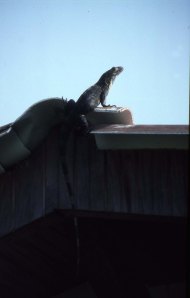
The usual cabin roof-top iguana mascot, ready for a long day of serious head-bobbing.

The head-nodding was easy to observe most days at La Pacifica eco-ranch, where we stayed for several days in August and September 1991. The occasional scritch-scraping of reptilian claws across the tin roof of the cabin told us that an iguana, usually about a metre long, had taken up position for a day of head-bobbing on the sunny roof apex.

A running iguana was altogether a much more uncommon sight. For one thing, the iguanas all seemed to be vying for the best vantage points high up on trees, rocks or buildings, and if they did move it was by a slow belly-dragging motion dictated by their low-slung bodies and splayed legs. But occasionally we startled one sunning itself at the side of the road and it would take off with a start, lurching away from the tarmac and propelling itself along by virtue of its whirring leg action. Needless to say it’s gait was rather ungainly, but it would thrash off into the undergrowth at quite some pace.

We more or less had the run of La Pacifica to ourselves. The eco-ranch was part  grazing land, part wilderness regeneration and part hotel. Ordinarily they would be host to various scientific meetings, scout camps, educational school visits and the like, but it was out of season and we were virtually the only guests.

During the day we would wander along the nearby River Corobici or into the surrounding woods, I’d be watching and photographing insects and Catrina would look at birds flying past or listen to the howler monkeys. One day saw us in a hay meadow down by the river. I was wading through the waist-high grass across the middle of the field, occasionally stopping to check out a large beetle or bug sitting atop a flower. Catrina was strolling, parallel, along the mown path that skirted the meadow, beside a narrow woodland.
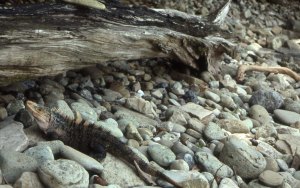
Perhaps the ugliest reptile in Central America: baggy, flaccid and ungainly. But they can move some.

As usual we had seen a few iguanas on the rocks down by the river and disturbed one, larger and greener than usual, from the narrow tarmacked track down through the ranch’s scattered cabins. The long grass of the meadow seemed an unlikely haunt for these large, ugly, snout-nosed reptiles, but as I adjusted my position leaning over a particularly large stink-bug, readying the camera for a close-up shot, a startled beast took off from close by, and thundered away in a madcap  careen. It was heading straight for Catrina, standing quietly on the path.

I can’t quite remember, but I may have shouted something helpful like: “Coming your way”. She didn’t need the warning, she could see the ridge of parting grass, and the wake of trampled stems. Things suddenly went into action movie slow motion. It was heading straight at Catrina, so she moved off, out of the way. But the crazed monster was wildly zigzagging and changed its tack to keep right at her. She moved the other way, but the animal’s trajectory changed with her.

By now Catrina had departed from character and adopted a stereotype scared  girlie pose, elbows in, hands on face, knees twisted, like some prim schoolmistress who has seen a mouse. She was probably screaming too. She obviously had visions of the scaly critter emerging and scrambling straight up her, instead of the nearest tree. It seemed to take forever, but could not really have been more than a few seconds. The frantic shape emerged from the edge of the long grass, right at Catrina’s feet and she braced herself for the seemingly inevitable assault.

It’s hard to say who was more startled — Catrina or the small terrified rabbit that bolted out of the greenery and almost crashed into her. At the last second it checked its course one last time and plummeted into the woods. A silence hung in the air. With Catrina’s breathless cries now stopped, I turned my attention back to that stink bug.

I found a psychedelic toothbrush

Coquettish, I thought, with that flick of the tail.

I’m not really very fussed about moths. What an awful confession for an entomologist to make. I can get excited about microscopic beetles, and often also about bugs, bees, ants, flies, obscure parasitoid wasps and even false scorpions. But moths? They’re just a bit tame really, aren’t they?

The words of Oliver Wendell Holmes ring very true in my ear: “Lepidoptera and Neuroptera for little folks; Coleoptera for men, Sir!”

Perhaps it’s because I never went through a moth phase on my early entomological journey. I went more or less straight from butterfly collecting to beetles.

However, I do like caterpillars. As they’re wingless perhaps I think of them as honorary creepy-crawlies. And this is one of my favourites — the psychedelic toothbrush that is the caterpillar of the pale tussock moth, Calliteara pudibunda. With its all-along lilac side bristles, its delicate yellow tail blush and the extraordinary black velvet intersegmental flashes, it presents itself a bizarre creature.

This one had chosen a peculiar resting place; it was tucked deep inside the chiseled hole made by a woodpecker in a willow tree on the banks of the River Stour, near Sandwich. Perhaps it reasoned that having dug there once and moved on, the bird was unlikely to return. Something a bit like lightning not striking the same place twice? I prodded it with a grass stem and it shuffled out for a picture before heading further up the trunk.

It is definitely one of my favourite caterpillars. What a pity it turns into such a dull-looking moth.

You just can’t beat gruesome

It’s a bug-eat-bug world out there.

A family-oriented bioblitz in the middle of Deptford was never destined to find many great rarities, but it did turn up some memorably disgusting behaviour.

I don’t think enough is made of cannibalism. It’s one of those taboo subjects best avoided by serious natural history documentaries. But it makes a great spectator sport, especially for children.

So when two harlequin ladybird larvae turned on each other I knew my audience was hooked. Despite squeamish grimaces, they kept coming back, just to see how much oozing of body fluids was going on, and to double check the mandible action of the victor.

The woodworm’s revenge

I’m starting a new project, a book on house guests and house pests, a natural history of the animals that invade our homes. I’ve been lucky enough to find plenty of animals in my own homes.

Mealworm beetles flew in through the open windows of the flat in Peckham; sparrows and starlings were nesting in the roof space when we moved into a half derelict house in Nunhead Grove; biscuit beetles floated to the surface in the milk of my breakfast shreddies in Bellwood Road, and here we flap ineffectually at clothes moths and scratch at the occasional cat flea.

I’m pretty relaxed about all of these interlopers. Even pulling back the old kitchen carpet — it was thick, pink, shag pile! — to reveal thousands of larder beetles (three species) and their larvae was more about enthusiastic exploration and focussed eradication than disgusted revulsion.

The only time I ever lost sleep over an animal in the room was on holiday on the Greek island of Lesvos (sometimes Lesbos). Having abandoned our cheap package holiday pension because it was so noisy from other guests, we upped and shipped out to the local fishing village of Molyvos, where we found a room in a guest house in the steep cluttered streets of the old town.

The nights here were silent, perfect, but just beside my ear I could hear an insect chewing in the wood of the small bedside cabinet. It wasn’t loud exactly, more persistently and irritatingly irregular. It was gnawing, and just as the jaws of my unseen persecutor rasped at the wood, so too the jarring scrapes rasped at my not-quite-unconscious mind.

Banging on the wood would shut it up for a short while, but, inevitably, just before I finally drifted off to sleep it would set up again — screek, screek, screek. The offending piece of furniture was a small spindle-legged cupboard, simple, barely ornamented, and probably meant to house a po, or perhaps other night-time accoutrements. But it only had three legs now. The remains of the fourth spindle, a short stump, hanging down like a damaged stalactite, clearly showed that it was riddled with the smooth tunnels of some chewing insect.

From the diameter of the tunnels maybe 5–7 mm, I’m guessing house long-horn, Hylotrupes bajalus, or perhaps golden jewel beetle, Buprestis aurulenta. Hylotrupes is apparently native to the Atlas Mountains of North Africa, but the forests of this area have been cleared long ago in antiquity, and instead it ekes out a living in building timber across much of Europe, South Africa and North America. Buprestis is native to the Pacific coast of North America, but furniture made from infested timber is shipped all over the world; adult beetles can emerge years (or decades) later.

I never saw an adult beetle, and after a couple of interrupted nights I stuck the cupboard out into a corner in the hallway for other guests to trip over. Peace at last. Apart from the American woman getting stuck in the lavatory in the middle of the night, and the dormouse dropping its dropping into my coffee cup, the lasting memory I have of this lovely old guest house is the grinding noise from the bedside table, which kept me awake at night.